Annual basketball backstop inspections: A checklist for school facility managers
Key Highlights
- Inspect backstops at least annually, and consider more frequent checks in high-use gyms.
- Check structural attachments, cables, winches, restraints, folding hardware, boards, rims, and padding.
- Use qualified technicians for comprehensive inspections and follow the manufacturer’s instructions for each system.
- Document inspection dates, findings, photos, and corrective actions at the facility.
- Take equipment out of service when damage could affect safe operation, and repair or replace it before use resumes.
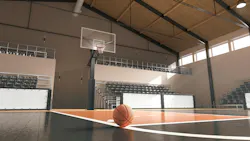
Ceiling-suspended and wall-mounted basketball backstops are heavy mechanical systems installed in spaces used by students, athletes, and spectators. They wear with ordinary use, and a missed problem can take a gym out of service—or worse. A 2026 industry guide, ASTM F3783-26, gives school facility managers a practical framework for inspecting this equipment at least once a year, keeping records, and deciding when to repair or replace a unit.
Why it matters
These backstops are easy to leave off a preventive maintenance schedule. They spend much of the day folded against a wall or ceiling, and if the board still goes up and down, it is tempting to assume the system is fine. Cables, winches, attachment hardware, and other moving parts can deteriorate through normal use. Manufacturers already recommend or require periodic inspection and service because a mechanical failure can cause property damage or injury.
What the ASTM guide covers
Earlier this year, ASTM International published F3783-26, Standard Guide for Inspections and Maintenance of Permanently Installed Indoor Gymnasium Equipment, which AS&U covered in a recent article on its release. It covers ceiling-suspended and wall-mounted basketball backstops and also addresses related overhead systems such as volleyball equipment, divider curtains, and wrestling mat lifts. Other gym equipment may fall outside its scope.
ASTM describes F3783 as a guide rather than a specification: It does not set detailed pass-fail tolerances. It offers a broader framework for inspection, service, and maintenance, and it recommends that covered equipment be inspected and serviced as needed at least once each year. High-use gyms may need more frequent inspections because wear tracks use, not only the calendar.
The guide is a voluntary consensus document. It does not automatically carry the force of law, though an agency, contract, code, or insurer may adopt or reference it. It also does not replace electrical, fire-safety, padding, or other requirements that already apply. Use it as a common framework, and still follow the manufacturer's current instructions for each exact system, along with any local or institutional rules.
Annual basketball backstop inspection checklist
Build the inspection around those manufacturer directions and the guide's purpose: Find wear before it becomes a mechanical failure. The walk-through below is a practical checklist, not a substitute for the published guide or a model-specific manual. If a structural part, cable, strap, winch, or attachment shows damage that affects safe operation, take that backstop out of service until a qualified technician corrects it.
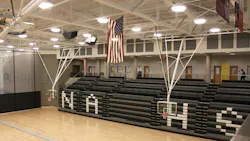
Ceiling-suspended units
Start at the building connection, not at the rim. From the floor, much of the load path is easy to miss.
- Confirm that attachment hardware, mounting brackets, and beam clamps are present, secure, and free of obvious defects, and that they have not shifted.
- Inspect the structure, braces, and welds for cracks, bends, or missing fasteners.
- Run the winch or hoist through a full raise and lower. Listen for grinding, slipping, or a brake that does not hold, and check that the operator can see the equipment while it moves.
- Inspect cables for fraying, broken wires, kinks, rust, or wear at the drum and pulleys.
- Confirm that safety straps or other secondary restraints specified for the unit are attached and engaging.
- Check height adjusters, if present: They should move as designed and lock at the intended settings. Inspect the backboard, rim, and padding for cracks, loose mounting, a rim that is not level or tight, worn or hazardous nets, and padding that is missing, torn, or leaving sharp edges exposed.
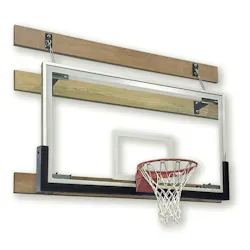
Wall-mounted systems
Wall-mounted backstops carry load into the wall rather than a ceiling superstructure, but the same idea applies: Inspect the attachment first. Check wall anchors, mounting plates, and structural connections for looseness, missing hardware, cracks, or movement. Inspect hinges, swing or fold hardware, and braces for wear or missing fasteners. Operate the unit through its full range and apply the same cable, winch, safety-strap, height-adjuster, board, rim, and padding checks that apply to that model. Confirm that stored and playing positions still clear lights, HVAC, curtains, bleachers, and other gym equipment.
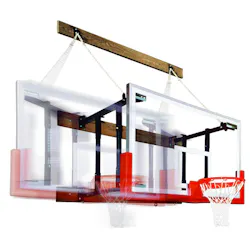
Fold-up backstops
Many school gyms use forward-fold or rear-fold ceiling units, or wall-mounted swing-up designs, to clear the floor for other activities. Check folding hinges, locks, and any catch or latch that holds the unit in the stored position, and pay particular attention to safety straps or secondary restraints on upward-folding units. Confirm that cables and pulleys still track correctly through the fold and that nothing binds or jumps a sheave. When the unit is stored, check clearance and make sure it cannot drift or drop. Follow the manufacturer's procedure for any operational test; do not improvise load or "push" tests.
Who should inspect gym equipment?
The annual inspection is specialized work. A technician who knows gymnasium equipment is better suited to a comprehensive yearly inspection than a general building technician who has not been trained on this equipment. Many districts contract that annual visit to a qualified service provider and train custodians, coaches, or in-house staff to report obvious problems between visits.
Follow the manufacturer's service requirements and any local, insurance, or institutional rules that apply. The guide helps owners and operators set practices; it is not a license to skip the instructions that came with the equipment. A control that has been taped down, or placed where the operator cannot see the unit move, is a practical red flag.
Keep inspection and maintenance records
Write the inspection down and keep the file at the facility. Record the date, the gym or court, the inspector, the findings, and the corrective action taken, with photographs of defects. Keep model information, installation documents, prior service reports, and warranty terms with those records so later work matches the equipment actually in the gym. A complete file also shows whether the same issue keeps coming back, and whether parts are still available for that model.
When to repair or replace a basketball backstop
Not every failed inspection means a new backstop. A worn net, damaged padding, a replaceable rim, or a cable and hardware service on an otherwise sound structure is often a repair. Replacement becomes the more practical path when a structural member, weld, or wall or ceiling attachment is damaged; when major parts are worn and no longer available; when repeated repairs no longer keep the unit reliable; or when the unit no longer meets the school's use.
Use compatible parts specified for that exact system. Do not substitute hardware or cable guessed from a similar-looking unit. If the backstop has been taken out of service, leave it out of service until the repair or replacement is complete and the unit has been checked for safe operation.
Plan ahead to avoid unexpected repairs
The most practical window for many schools is summer or early fall, when the gym is more available and there is time to order parts or schedule a replacement before winter sports. That is a scheduling preference, not a requirement in the guide. High-use gyms may need a mid-year check as well. Build inspection, service, parts, and a possible replacement into the maintenance and capital plan, and place likely replacements on the calendar before a mid-season failure.
When you specify a new or replacement backstop, settle the fold type, mounting method, height-adjustment needs, padding, clearances, and the manufacturer's inspection requirements before the order. An annual inspection program will not eliminate every repair. It gives facility managers a regular point to find wear, document condition, take unsafe equipment out of use, and plan the next expenditure around the school year rather than around an emergency.
About the Author
Daniel Cox
Daniel Cox is the owner of Quality Hoops, an Oklahoma City-based supplier of basketball goals and gymnasium equipment for schools, parks and facilities. He can be reached at (405) 339-0055 and [email protected]. Learn more about basketball goals for schools at https://qualityhoops.com/pages/basketball-goals-for-schools.
Related
 dreamstime_xxl_88147492