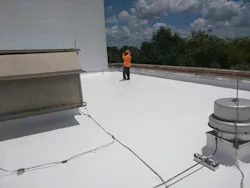
Deferred maintenance is a problem that constantly nags at school facility managers as they try to keep their buildings operating safely while staying within budgets that can’t cover all the work that is needed. One of the prime spots where a school or university may be tempted to temporarily hold off on such work is on the roof of a building—almost no one can see what is going on up there, so it’s easier to defer those jobs and instead focus on repairs and maintenance where people can see...and complain about when the problems linger or become worse.
The problem with forgoing inspections and putting off minor roof repairs is that the unchecked damage and the leaks that result can lead to major facility breakdowns. Ceilings, walls and floors can be ruined, electrical and mechanical systems wrecked. There’s also potential harm to the students and staff inside the school building. Leaking roofs let unwanted moisture inside and create conditions for dangerous mold to grow unseen and cause health problems.
But research indicates that at too many schools, those inspections aren’t happening often enough. A 2020 survey by the U.S. Government Accountability Office estimated that about 28,000 schools needed their roofs updated or replaced.
Regular inspections of roofs will help school maintenance workers monitor conditions and detect damage or deterioration before they cause more serious infrastructure problems that can compromise an entire building. Roofing experts recommend inspecting roofs at least twice a year, in the fall and in the spring. Springtime inspections make it possible for school personnel to determine if their roofs emerged from the harsh winter months with any new problems that need to be addressed.
Looking for water
Roof inspections should focus first on whether water or other unwanted moisture can be seen.
“The key to maintaining good roofs is the timely removal of water from the surface and substructure of the roof,” says the National Center for Education Statistics Planning Guide for Maintaining School Facilities. “Thus, all leaks and damaged tiles must be repaired as soon as possible to prevent water damage and mold growth.”
The National Center on School Infrastructure’s Facility Condition Assessment Manual says roof inspectors should look for “soft” spots on a roof that may indicate water intrusion.
“If you encounter soft spots on the roof, it’s best to walk through the inside of the building,” the manual says. “Look for water stains on the ceiling tiles or missing tiles.”
Inspections also should include an examination of parapet walls and HVAC curbs to make sure nothing is leaking through. “The majority of water intrusion issues can be found in these transition points,” the manual says.
The manual also urges maintenance workers to look closely at roof membranes for exposed areas, signs of wear, blisters or punctures. “Look for any mildew, moss or debris on the roof that may cause a breakdown in the membrane,” it recommends. Inspect roof membrane seams for signs that the seam is no longer adhering. “Seams are typically the first point in low-slope roofing systems that degrade,” the manual says. “This will cause blistering and water pooling...and will become a perfect spot for water intrusion over time.”
Inspectors also should examine roof repairs that have been made in the past to see if they have affected the overall roof performance.
“A roofing system over time will leak and the facility team may start to fill these areas with a roof repair kit,” the manual says. “Sometimes the roof repair material does not match the membrane. This will eventually make the issue worse over time.”
Going for three
Many education institutions aren’t able to carry out two roof inspections a year. But Davenport University, with several campuses in Michigan, has committed to as minimum of three yearly inspections of the roofs on all university buildings.
“Roofs will be visually inspected in early April, July and late October,” Davenport’s website says. “Roofs will also be inspected after each incidence of extreme inclement weather.”
The website provides a detailed list of the potential problems inspectors should look for: missing or damaged shingles; deteriorated flashing; standing water or ponding; debris laying on roof; debris clogging roof drains; open, torn, punctured, cracked, separated or blistered rubber membrane and seams; missing chimney or vent caps; gaps and breaks between the metal edging and the roofing membrane; empty or improperly installed pitch pockets; missing or open caulk joints; poor or missing seals around roof access ladders, HVAC equipment, and other roof penetrations; damaged soffits, fascia, and vents; and missing or damaged downspouts and gutters.
“Where feasible, university facilities staff will correct ‘routine’ roof deficiencies, such as removal of debris from the roof and around roof drains, or replacing vent caps,” the university says.
About the Author
Mike Kennedy
Senior Editor
Mike Kennedy has been writing about education for American School & University since 1999. He also has reported on schools and other topics for The Chicago Tribune, The Kansas City Star, The Kansas City Times and City News Bureau of Chicago. He is a graduate of Michigan State University.