Reimagining library spaces: From dead zones to dynamic learning hubs
Key Highlights
- Many libraries have over half of their collections unused, occupying space that could be repurposed for more engaging student activities.
- Reclaiming 40-60% of library space allows for flexible study environments, collaborative zones, and technology-enabled areas aligned with current learning behaviors.
- Organizing library zones from energetic, collaborative centers to quiet, focused study areas creates a dynamic environment that caters to diverse student needs.
- Centralizing student support services within the library, as exemplified by King’s College, enhances visibility and accessibility, reinforcing the library’s role as a campus hub.
- Thoughtful redesigns that reflect institutional mission and student behavior can transform libraries into vibrant symbols of campus innovation and community.
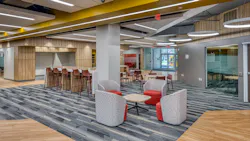
At many institutions of higher learning, libraries are strapped with stacks and stacks of books, many that have not been touched in five or even ten years. As librarians review usage data, an inconvenient truth emerges: in some cases, more than half of a library’s collection remains unused, occupying valuable real estate that could otherwise serve students in more meaningful ways. Reclaiming this space presents a significant opportunity to bring vibrancy back to libraries by creating flexible study environments, collaborative work areas, private carrels, and technology-enabled learning spaces.
The question for college and university administrators is not simply how to free up the space, but how to do so in a way that aligns with the institution’s mission and brand. By re-imagining “dead space” or underused areas of the library filled with seldom-used books, academic institutions can integrate design, mission, brand, and purpose in a thoughtful way. This not only helps current students but also creates a showpiece on the campus tour that allows prospective students to envision themselves as part of a vibrant intellectual community.
Reclaiming underutilized space
With thousands of resources available online or in digital forms, institutions should take it upon themselves to remove outdated or digitally accessible materials. In doing so, we have seen libraries reclaim 40 to 60 percent of their usable area.
From both an architectural and operational standpoint, this represents a significant opportunity to reconfigure the space so the library becomes a central hub of learning, collaboration, and campus activities. Libraries, with their expansive floor plates, often generous ceiling heights, robust structures, and central campus locations, are among the most flexible (adaptable) buildings on campus. Reimagination and reconfiguration breathe new life not only into the building, but into the whole of the campus experience. Nearly as importantly, reprogramming existing library space is often one of the most cost-effective ways to address unmet needs without new construction, allowing institutions to redirect limited dollars toward experiences that directly support students.
Library Transformation and Its Impact on Students
Library transformation not only refreshes spaces but can directly impact student matriculation and institutional perception. For prospective students and families, the library often serves as a powerful symbol of campus vitality. A library that feels active, welcoming, and purpose-driven signals investment in the student experience.
Students want to imagine themselves in the library, studying for exams, collaborating with peers, or spending time in a space that supports academic and daily life. In this sense, the library communicates institutional values.
Creating Dynamic and Collaborative Spaces through Zones
The most effective contemporary libraries are organized by zones rather than silos. Spaces are layered by activity level, acoustics, and privacy. Similar to the solar system, zones should start at the center and radiate outward, from the most collaborative and loudest areas to more private and quieter ones on the outer rings. At the center is an open, energetic zone with flexible furniture and comfortable seating, often accompanied by a café offering food and coffee. In this area would be a buzz of activity, with furniture that fosters student collaboration or working “alone together.” For students not working in groups, many increasingly prefer the option to work alone while remaining embedded in a shared social environment.
As one moves outward, spaces become progressively quieter. Group study areas provide acoustic separation without isolation, while individual study zones support deep focus. Traditional cubicles give way to enclosed, comfortable, technology-enabled spaces designed for extended use. Physical collections remain, but they are scattered throughout the broader ecosystem. This way, the library feels more collaborative and less like a monolithic relic.
Case Study: King's College
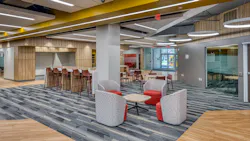
King’s College in Wilkes‑Barre, Pennsylvania, had a strong value proposition to prospective students: “Come to Kings and you will graduate on time and with employment”—and they lived into it. King’s has a robust Student Success Support system of writing centers, wellness centers, language support, writing support, math support, mentors, and tutoring. What they didn’t have was any way to show it, as these individual services were scattered across the campus. While the services themselves were strong, their physical invisibility didn’t limit their success, but it did limit the ability to show the depth and meaning to prospective students.
It was already decided that improvements had to be made to the Library, but the “eureka moment” came in an early planning meeting, when we suggested bringing all those services to the Library in the resultant space and creating a Student Success Center in the heart of campus—and we did just that. If you walk into the library now, the building has been opened up, and positively, like shopping malls of the past, you can look across the space and see the Tutoring Center, Writing Center, Math Center, Center for International Students, Wellness Center, and more. All of these suites are wrapped around the Learning Commons where collaboration spaces meet traditional library services.
King’s College understood their library needed to be more, and the answer was right in their own mission and value proposition. All we had to do was bring those truths together, and the rest of the story wrote itself.
The Strategic Importance of Library Transformation
Reimagining the modern academic library is not simply a design challenge but a strategic opportunity to infuse academic mission and brand. By reassessing underused collections and reclaiming valuable space, institutions can align their physical environments with how students actually learn and collaborate today. Transforming “dead space” into dynamic, purpose-driven zones allows libraries to support academic success better while reinforcing institutional identity and mission.
Thoughtful library redesign, grounded in real student behavior and supported by accessible, centralized services, can elevate the library from a static repository into a vibrant hub of campus life. These revitalized spaces not only enhance daily student experiences but also serve as powerful symbols of innovation and investment for prospective students.
Ultimately, by choosing a design that promotes flexibility, collaboration, and visibility, colleges and universities can ensure their libraries remain impactful and central to the academic journey while reinforcing their brand and supporting the attraction and retention of the best students.
Martin Kimmel, AIA, NCARB, is Founding Principal and Chief Creative Officer of Kimmel Architecture (formerly Kimmel-Bogrette Architecture + Site), a nationally recognized architecture and interior design firm headquartered in suburban Philadelphia, Pennsylvania, and specializing in delivering for Mission Driven Owners in senior living, healthcare, education, and government.