The role of flexible systems in campus modernization and decarbonization
Key Highlights
- Flexible infrastructure enables campuses to adapt buildings for new programs, technologies, and sustainability initiatives without costly renovations.
- Early planning and strategic rightsizing of systems help balance current needs with future expansion, reducing long-term costs and risks.
- Supporting systems like power, ventilation, and data networks are critical for repurposing spaces efficiently and sustainably.
- Designing modular, accessible pathways and utility corridors facilitates phased development and minimizes operational disruptions.
- Integrating resilience strategies, such as backup power and microgrids, ensures continuity during disruptions and supports decarbonization efforts.
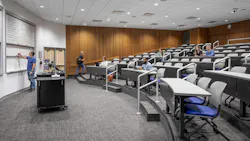
When a campus building becomes obsolete, it’s rarely because a classroom wall can't be moved. More often, it’s because of the parts of the facility that students and faculty never see. It is above in the ceilings, behind the walls, beneath the campus, and inside the central infrastructure systems that support multiple facilities at once. Infrastructure determines whether a facility can adapt to new programs, technologies, and energy strategies.
In an environment with shifting enrollment patterns, quickly evolving academic programs, constrained funding, new technologies, campus decarbonization goals, and scrutinized capital investments, it is critical to build for flexibility. For colleges and universities, planning for that flexibility starts with the infrastructure that enables change at both the building and campus scales.
Innovation on campus is often visible in new labs, learning environments, and research programs. But the ability to support facility upgrades depends on less visible systems: power, ventilation, controls, utilities, data infrastructure, and energy networks that can evolve as institutional needs change.
From static to adaptable
Historically, institutions designed campus buildings around a defined program with limited expectation of change. A science building served a stable academic function. A classroom building supported consistent instructional needs. Engineers sized and configured systems accordingly.
That approach no longer reflects how institutions operate.
Programs expand and contract. Departments merge or relocate. New disciplines emerge, requiring different types of space and infrastructure. Even within a single building, uses can shift significantly over time, from classrooms to labs, from offices to collaborative environments, or from general academic space to specialized research.
Emerging academic programs may require more sophisticated technology, higher energy loads, enhanced ventilation, specialized equipment, or more flexible research environments. A building that once supported traditional instruction may need in the future to support interdisciplinary research, simulation, makerspaces, or advanced computing.
Those changes do not stop at the walls of an individual building. When an art building becomes a research facility, or a traditional classroom building begins supporting more energy-intensive programs, the impact extends to power, chilled water, heating systems, controls, and the broader campus utility network.
When buildings are designed without this level of change in mind, institutions risk costly renovations, operational disruptions, and, in some cases, facilities that can no longer support their intended use.
Flexible infrastructure provides institutions with more options before complete reinvention becomes the only path forward.
Infrastructure limits
One of the most common misconceptions about flexible design is that it is primarily an architectural problem. But really, HVAC systems, electrical capacity, distribution pathways, controls, and utilities determine whether a space can be repurposed efficiently or at all.
For example, converting a classroom into a laboratory is not simply a matter of reconfiguring furniture. It requires sufficient ventilation, appropriate air changes, specialized exhaust, additional power, and often upgraded controls. If those systems were not anticipated in the original design, the cost and complexity of retrofitting can be significant.
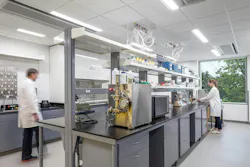
For institutions, this is where innovation can either accelerate or stall. A campus may have the academic vision for a new program. It may even have the space available for it, but if the infrastructure cannot support the required equipment, environmental controls, power demands, or connectivity, the project becomes more expensive, more disruptive or less feasible. Flexible infrastructure gives institutions more room to pursue new ideas without being constrained by systems designed for yesterday’s needs. Without early infrastructure planning, institutions may find that the biggest barrier to reuse is not the building itself but the systems that feed it.
The same is true for technology infrastructure. As digital tools, research requirements, and data demands continue to grow, buildings must be able to accommodate higher loads, greater connectivity, and more sophisticated systems than originally envisioned.
In this sense, flexibility is less about creating generic space and more about building the capacity and pathways that make change possible.
Rightsizing without overbuilding
Institutions often struggle to balance existing needs with future uncertainty. Designing systems to account for every possible scenario can quickly strain the budget. At the same time, designing too narrowly limits future options and increases long-term costs.
A more effective approach is to focus on strategic flexibility within the building’s infrastructure. This means right-sizing systems for current demand while incorporating targeted provisions for future expansion.
In practice, that often means distinguishing between capacity that needs to be installed now and capacity that should simply be planned for. Institutions may not need to purchase and install every piece of equipment on day one, but they should consider whether the building has the space, pathways, and connection points to support future growth.
This is especially important for phased development. Rather than constructing buildings or infrastructure to ultimate capacity immediately, campuses can build what is needed now while planning for expansion as funding, enrollment, and program demand become clearer.
Practical strategies include planning for additional capacity in electrical rooms or central plants, even if not all equipment is installed initially; providing clear distribution pathways, such as accessible ceiling space or utility corridors, that enable systems to expand without major disruption; designing modular systems that can be incrementally scaled as needs evolve; and incorporating adaptable controls that can support different space uses over time.
These approaches enable institutions to manage upfront costs while preserving future options. Done well, rightsizing is not about building less or building more. It is about making targeted infrastructure decisions that reduce financial exposure today while protecting long-term value.
Flexibility and sustainability
Flexibility and sustainability reinforce each other.
Buildings that can adapt over time require minimal renovations or replacement, reducing material waste and embodied carbon. At the same time, rightsized systems and phased investments help avoid unnecessary energy consumption and capital expenditure.
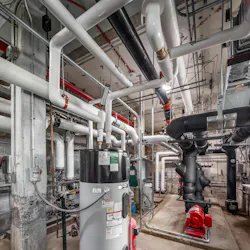
Flexible infrastructure also helps institutions keep pace with evolving sustainability goals. As colleges and universities pursue decarbonization, electrification, and other energy strategies, buildings must accommodate the latest advancements and system configurations.
This is especially important on existing campuses, where innovation and sustainability are closely connected. Decarbonization is rarely achieved through a single project. Institutions may need to transition away from legacy fossil-fuel systems, evaluate central plant strategies, incorporate heat recovery, add renewable energy sources, improve controls, or prepare for greater electrification over time. Each decision affects the next, and each one depends on infrastructure that can accept change.
Campuses that plan for adaptability are better positioned to test, scale, and integrate emerging solutions without treating every advancement as a significant retrofit. It also helps institutions lower long-term energy costs by aligning capital planning with operational performance rather than treating sustainability as a separate initiative.
Modernizing without interruption
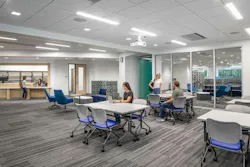
The Science Complex at Butler University in Indianapolis, Indiana, shows how systems-led planning can support modernization without stopping campus operations. The university upgraded mechanical and electrical systems for a major expansion and renovation of Gallahue Hall and Holcomb Hall.
The project transformed two older academic buildings into a refreshed science complex supporting classrooms, private study areas, a library, chemistry, and research labs, common spaces, and a new glass-enclosed atrium connector. The work was completed over four years, enabling the university to continue offering a full curriculum while construction was underway.
That phasing required careful coordination of the infrastructure behind the learning environment, including scheduled shutdowns, access to critical spaces, noise mitigation, and continued support for classes and research experiments. In addition to bringing the building up to current codes and standards, the renovation created flexible and resilient infrastructure that the university needed moving forward.
For higher education leaders, the lesson is clear: flexibility is not only about what a building can become years from now. It is also about how effectively institutions can renew, expand, and modernize existing facilities while keeping academic life moving.
Resilience and uncertainty
Resilience adds another reason to prioritize flexible infrastructure.
Utility cost volatility, grid instability, and extreme weather place growing pressure on campus infrastructure. As a result, many institutions are rethinking how infrastructure supports not just day-to-day operations, but also continuity during disruptions. This includes evaluating backup power strategies, on-site energy systems, and more intentional load prioritization.
For a college or university, resilience may not carry the same life-safety urgency as a hospital, but the consequences are still significant. If campus infrastructure fails, institutions may be forced to cancel classes, relocate students, pause research, shut down residence halls, or send students away. That disruption affects academic continuity, student experience, research activity, and institutional reputation.
Embracing flexibility
These steps will help education institutions incorporate flexibility in their facility decisions.
1. Plan for innovation, not excess
Rightsize systems for today, but design systems with the flexibility to support tomorrow.
2. Prioritize distribution and access
Accessible ceilings, utility corridors, and clear routing make future changes faster and less disruptive.
3. Think in systems, not spaces
A room can change function quickly, but only if the infrastructure supporting it can adapt.
4. Align early on long-term goals
Flexibility requires early collaboration between facilities, design teams, and leadership to define priorities and tradeoffs.
5. Connect building decisions to campus energy strategy
Evaluate how each project affects decarbonization, electrification, resilience, utility costs, and long-term infrastructure planning.
As energy technology continues to evolve, campuses do not need to solve every resilience challenge at once. But they do need infrastructure that enables them to adopt better solutions as they become practical, affordable, and aligned with institutional goals. Flexible infrastructure makes it easier to integrate these solutions over time, from backup power and renewable generation to battery storage, distributed energy resources and microgrids.
These strategies can help campuses think more intentionally about continuity. Rather than treating all loads equally, institutions can determine which functions must remain operational during an outage, which buildings or systems should be prioritized and which loads can be temporarily reduced.
The goal is not to make every building fully independent. It is to make smarter decisions about continuity, cost, and risk.
Collaborative approach
Achieving meaningful flexibility requires a shift in project mindset.
Teams cannot add it late in the design process or address it with a single decision. It requires early alignment between administrators, designer,s and engineers on long-term goals, potential future scenarios and acceptable levels of risk.
It also requires a willingness to think differently. The most innovative campuses are not just adding new technologies. They are building infrastructure that can keep adapting as academic, energy, and operational needs evolve. This requires holding conversations about future academic programs, energy priorities, resilience needs, and funding realities before design decisions become fixed.
From an engineering perspective, the role extends beyond delivering systems. Engineers can serve as a strategic partner, helping institutions navigate complex decisions and build infrastructure that supports their mission over time.
Flexibility ultimately comes down to making better long-term decisions.
It enables institutions to respond to change without starting over. It reduces the risk of obsolescence. It supports decarbonization without forcing disruptive, one-time overhauls. It helps campuses manage energy costs, protect continuity, and extend the value of major capital investments.
By prioritizing flexible infrastructure, colleges and universities can make campus investments that are cost-conscious today, while remaining resilient, efficient, and adaptable for the future.
About the Author
Daric Hess
Daric Hess is Chief Innovation Officer at HEAPY, an engineering firm based in Dayton, Ohio.