First new U.S. Virgin Islands school in 27 years opens on St. Croix
Key Highlights
- The school replaces facilities damaged by Hurricanes Irma and Maria, serving as a major educational and community hub on St. Croix.
- Design involved extensive community input, ensuring the school meets local educational and environmental needs.
- Resilience features like solar power and water storage enable quick recovery after storms, with the gym functioning as a storm shelter.
- The project employed up to 270 local tradespeople, supporting the U.S. Virgin Islands' workforce and economy.
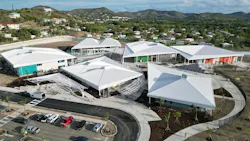
For the first time in 27 years, a new school in the U.S. Virgin Islands has opened with the completion of the Arthur A. Richards PreK-8 School on St. Croix. Designed in collaboration with MCN Build, Perkins Eastman, and DLR Group, the 139,000-square-foot campus replaces facilities that were damaged by Hurricanes Irma and Maria and is now the largest school in the territory, which can accommodate up to 735 students who were welcomed into the new facility on Aug. 7th.
Built on the former Evelyn M. Williams Elementary School site, the campus was designed to address both day-to-day educational needs and the realities of operating schools in a hurricane-prone region. Perkins Eastman Principal Mary Rankin said in a press release that the design process began with input about what students and the St. Croix community needed from the new school:
“From the beginning, our process was about listening—to the community, to the environment, to what students in St. Croix actually need from their school.”
The campus includes 32 classrooms, three labs and maker spaces, a dedicated early-learning building, shaded outdoor areas, and a central gathering space. Smaller learning communities were also incorporated into the plan to keep classroom groups more closely connected.
Resilience measures include on-site water storage and solar power designed to help the school resume operations more quickly after a major storm. The gymnasium is also designed to function as a storm shelter for the local community.
The project also relied heavily on the local construction workforce, with resident firm CariBuild serving as part of the design-build team as well. According to the announcement, there were up to 270 tradespeople working on the site at once during peak activity, and about 400 workers over the course of the project came from the U.S. Virgin Islands labor pool.
The project moved from groundbreaking to ribbon-cutting in about two and a half years.