Designing career and technical education spaces for the AI era
Key Highlights
- Career facilities should facilitate repeated, realistic practice opportunities that connect students with industry and foster skill development.
- Design spaces that support testing, troubleshooting, collaboration, and immediate feedback to help students build judgment and adapt to AI-driven work environments.
- Incorporate flexible, interactive environments that shorten the path from novice to competent, emphasizing verification, diagnosis, and decision-making skills.
- Educational spaces must evolve to prepare students for AI's impact, focusing on responsibility, critical thinking, and collaboration rather than routine task reproduction.
- Facilities should align with federal policies emphasizing career pathways, work-based learning, and AI literacy to better prepare students for future workforce demands.
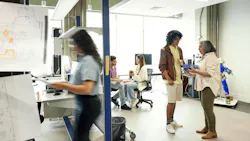
The best career facilities do more than house equipment. They create repeated opportunities to practice work under realistic conditions.
American School & University’s recent profile of the KRESA Career Connect Campus captures that purpose. The two-story facility brings together advanced manufacturing, information technology, agriculture, health sciences, culinary programs, and supply-chain management, with hands-on learning and connections among students, educators, and industry partners.
How AI is changing entry-level workforce preparation
AI changes what those spaces need to teach.
Stanford Digital Economy Lab researchers using ADP payroll data through June 2026 find that employment among U.S. workers ages 22 to 25 in highly AI-exposed occupations stands about 19% below where it would be if employment had kept pace with similarly aged workers in less-exposed occupations. The comparable gap was 15% in the July 2025 data vintage. Most adjustment appears through reduced hiring, and the declines concentrate where AI tends to automate human tasks. Experienced workers show no comparable gap.
For schools and colleges, that shifts a facilities question into a workforce question: What kind of environment helps a beginner build judgment after software absorbs more routine preparation?
Designing spaces for testing, troubleshooting, and collaboration
A computer lab should support more than prompt-writing. Students need stations where they compare AI output with source material, test calculations, document errors, and explain why a recommendation failed. A health-sciences space should make room for scenario work in which students confront missing information and unusual cases. A manufacturing lab should pair automated analysis with physical inspection, troubleshooting, and escalation decisions. Collaborative rooms should support coached reviews where students defend choices to instructors and industry mentors.
The physical design matters because development depends on visibility and interaction. Instructors need to see work in progress, not just final output. Students need places to compare approaches, receive immediate correction, and observe more experienced practitioners. Flexible spaces should accommodate short cycles of attempt, review, revision, and greater responsibility.
Federal education policy is already emphasizing career pathways, work-based learning, AI literacy, and closer links between education and employers. Facilities can translate those priorities into daily behavior.
A new measure of success for CTE investments
School leaders should add one criterion to capital planning for CTE, STEM, and technology spaces: time to independent competence. Ask whether a proposed environment shortens the distance from novice performance to reliable performance on a defined task.
That question changes procurement. A flashy AI classroom with rows of screens can score poorly if students mostly generate output alone. A modest lab with flexible workstations, review surfaces, mock client scenarios, and room for mentor interaction can score highly if students repeatedly verify, diagnose, communicate, and decide.
Education facilities have always embodied assumptions about how people learn. AI makes one assumption especially important: students should spend less time reproducing routine output and more time learning to take responsibility for difficult work.
The next generation of career spaces should be designed around that transition.
Gleb Tsipursky, PhD, a behavioral scientist, CEO of Disaster Avoidance Experts, and author of The Psychology of AI Adoption at Work: From Resistance to Results (Georgetown University Press, 2026).