What is a school bond referendum—and how does it fund capital projects?
Key Highlights
- School bonds allow districts to secure upfront capital for long-term projects like new construction and major renovations.
- Voter approval thresholds and legal rules vary by state, influencing bond passage and project scope.
- Bond proceeds are typically used for infrastructure, safety upgrades, technology, land acquisition, and capital assets, not daily operational costs.
- A comprehensive planning process, including assessments and community input, is vital before placing a bond measure on the ballot.
- Post-approval, districts must manage project execution, oversight, and reporting to ensure transparency and accountability.

For many school districts, the gap between what facilities need and what the annual operating budget can afford is too big to close through yearly appropriations alone. Replacing a school, renovating multiple campuses, upgrading HVAC systems, or addressing decades of deferred maintenance can require hundreds of millions—or even billions—of dollars.
That’s where school bonds come in.
AS&U’s recent Bond Alert tracking shows how heavily districts continue to rely on this financing tool. Of 112 school bond measures scheduled for Nov. 3rd, 88 include modernization or renewal work representing about $19.1 billion in proposed funding. More than 30% address HVAC, roofing, or other core building systems, totaling roughly $5.5 billion, as noted in our analysis of enrollment trends uncovered in The AS&U 100 2026 ranking of the country’s largest school districts.
What is a school bond referendum?
By way of definition, a school bond referendum is simply a ballot question asking voters to authorize a school district or other public entity to borrow money for specified purposes. In a typical general obligation bond program, the district sells bonds to investors and receives money upfront for capital projects. The issuer then repays the principal, plus interest, over time. General obligation bonds are backed by the issuer’s taxing authority, while other municipal bonds may be repaid from a particular revenue source, according to the Securities Exchange Commission (SEC).
For school districts, the appeal is pretty simple in that large projects can move forward without waiting years to accumulate enough cash from annual budgets.
Voter approval usually authorizes the district to issue debt up to a stated amount. It doesn’t mean every dollar is borrowed immediately or that every project begins as soon as the election is certified, however. Bonds can be sold in phases as projects move through design and construction and as the district manages debt capacity, interest rates, and cash-flow needs.
The exact rules differ by state as well. Approval thresholds, allowable uses, debt limits, election requirements, oversight provisions, and tax structures are governed by state and local law. California, for example, allows qualifying school bonds to pass with 55% voter approval under Proposition 39, while other bond elections may require two-thirds approval, according to the California Department of Education.
What can school bond money pay for?
Bond proceeds are generally reserved for long-lived capital assets rather than day-to-day school operations. Depending on state law and the language voters approve, projects may include:
- new schools and replacement campuses;
- major renovations and modernizations;
- classroom additions and capacity expansion;
- roofing, HVAC, electrical, plumbing, and other infrastructure;
- safety and security upgrades;
- technology infrastructure;
- land acquisition; and
- certain furnishings, equipment, transportation, or other capital assets.
The allowable uses aren’t identical from state to state, so districts have to build the project list around their own legal requirements.
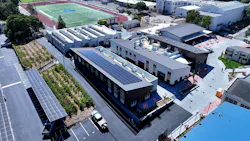
A recent example from AS&U is West Sonoma County Union High School District’s new Career Technical Education Center at Analy High School, which was funded through local Measure A bond proceeds. The district used the funding for specialized welding, culinary, agricultural science, technology, and flexible learning spaces rather than routine operating expenses.
How is a bond different from an operating levy?
The terms are sometimes used together on election ballots, but they serve different purposes, according to information made available by Scottsdale Unified School District:
- A bond is borrowed money that must be repaid with interest and is generally used for long-term capital improvements.
- An operating levy raises tax revenue for recurring expenses such as salaries, student programs, utilities, supplies, and other day-to-day costs. Some states also permit capital levies for shorter-term building, technology, or maintenance needs, which adds another layer of complexity.
For facilities leaders, the practical difference is that a bond can provide enough upfront capital to tackle projects that would otherwise be difficult to fund through annual budgets alone.
Why does facilities planning come before the referendum?
A bond election may be the most visible part of the process, but a well-developed capital program usually starts much earlier. Districts often begin with a facility condition assessment, enrollment and capacity analysis, educational adequacy review, demographic projections, or a facilities master plan. Those studies help identify which buildings need repair, renovation, replacement, expansion, consolidation, or repurposing.
The district then has to translate those needs into a project list, establish preliminary costs, determine debt capacity, estimate the tax implications, and decide what can realistically be delivered within the proposed program.
Dallas Independent School District followed that kind of process before placing its $6.2 billion bond package on the ballot earlier this year, as reported by AS&U earlier this year. The district began long-range planning in 2024 and used a steering committee and more than 65 meetings to help develop the proposal. Voters ultimately approved all four propositions, including nearly $5.93 billion for school construction, renovation, security, technology, and transportation improvements.
The amount voters authorize also needs to reflect more than today’s construction estimates. Escalation, phasing, professional fees, contingencies, financing schedules, and the time required to complete a multiyear capital program can all affect how far the money goes.
What happens after voters approve a school bond?
Approval is the beginning of the capital program, not the end of the planning process. The district still has to issue the bonds, complete design work, procure architects and contractors, obtain approvals, establish construction schedules, and manage projects through completion. Depending on the size of the program, bonds may be issued in multiple series over several years rather than all at once.
Accountability requirements also vary. Some states require independent audits, citizens’ oversight committees, performance reporting, or limits tying expenditures directly to the project list voters approved. California’s Proposition 39 process, for instance, requires annual financial and performance audits along with a citizens’ oversight committee.
Districts also have to coordinate new construction with existing operations. Swing space, attendance boundaries, temporary classrooms, construction sequencing, and school calendars can become as important as the financing itself.
Olathe Public Schools offers a current example in which the Kansas district’s Bond 2026 program includes replacing four elementary schools with two new facilities while some buildings slated for closure are used temporarily as swing space during construction. The bond program is therefore tied directly to the district’s broader work on enrollment, capacity, consolidation, and long-term facility use.
What happens if a bond referendum fails?
A failed bond vote doesn’t make the underlying facility need disappear. District leaders may have to delay projects, reduce scope, revise the financing plan, seek other funding sources, or return to voters with a different proposal. Also, urgent repairs may have to be funded from operating or capital reserves, which can put additional pressure on other priorities.
The consequences also depend on the projects involved. Delaying a new school in a growing district may prolong overcrowding, while postponing replacement of an aging roof or HVAC system can increase maintenance spending and the risk of failure. In other cases, slower enrollment growth may give a district an opportunity to reconsider whether a planned new building is still necessary.

Middleton School District in Idaho illustrates how financing can change when bond efforts don’t succeed. After five unsuccessful attempts to obtain voter approval for a new elementary school, the district turned to state facilities funding and a cooperative loan program to finance a 400-seat school.
5 questions districts should answer before seeking a bond
Before placing a proposal on the ballot, facilities and finance teams should be able to clearly answer a handful of practical questions:
- What problem are we trying to solve?
Is the district addressing enrollment growth, aging infrastructure, deferred maintenance, safety, educational adequacy, consolidation, or some combination of those needs? - Why these projects, and why now?
A prioritized project list should connect facility conditions and educational needs with the proposed investment. - How much will the full program cost?
Estimates should account for escalation, professional services, contingencies, phasing, and other costs beyond basic construction. - How will the debt affect taxpayers and the district’s finances?
Districts need to understand repayment schedules, assessed valuation, existing debt, tax impacts, and borrowing capacity before committing to a bond amount. - How will the district demonstrate that the money was spent as promised?
Clear reporting, project dashboards, audits, oversight, and regular capital-program updates can help communities track what has been completed and what remains.
Why this matters
A bond referendum isn’t simply a financing event. It sits at the point where facility conditions, enrollment trends, educational goals, long-range planning, and public finance come together.
The strongest capital programs begin well before a ballot question is drafted. District leaders need a credible picture of what their buildings need, how enrollment may change, which projects deserve priority, what the work will cost, and how the resulting debt fits into the district’s financial outlook.
With aging buildings competing against changing enrollment, energy upgrades, safety improvements, and new instructional demands, those decisions are becoming more complicated. The bond may provide the money, but the quality of the planning determines whether that money addresses the right problems.