Roanoke schools use $2.55 million in outside funding for Virginia’s first K-12 solar microgrids
Key Highlights
- Roanoke is installing 1 MW solar and 4 MWh battery systems at Patrick Henry and William Fleming high schools, serving as emergency shelters during outages.
- Funding includes a $450,000 state grant and $2.1 million private investment, with costs offset by energy savings and grid services, avoiding local budget impact.
- The project enhances resilience, allowing shelters to operate independently from the grid, and integrates roof repairs with solar installations to save costs.
- The district's solar program has expanded to nearly 9.4 MW across 29 sites, reducing electricity costs by over $22 million over 35 years.
- Secure Solar Futures provides workforce training and curriculum to prepare students for careers in renewable energy, integrating education with infrastructure upgrades.
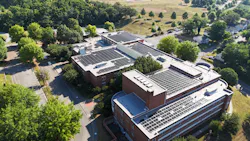
When it comes to resilience and sustainability measures, Roanoke City Public Schools is certainly making the grade, as it announced it is adding battery storage to solar installations at its two high schools, creating what the district says will be the first solar-powered microgrids at K-12 schools in Virginia.
The solar storage capabilities at Patrick Henry and William Fleming high schools are possible due to a state grant RCPS received for the array, which is expected to be installed by the end of 2026, according to an announcement by the district. Both campuses serve as designated emergency shelters, and the batteries will enable the buildings to continue operating on stored solar energy during power outages before diesel generators are needed.
Each high school will have 1 megawatt of solar generating capacity and 4 megawatt-hours of battery storage, for a combined 8 megawatt-hours of storage, according to a local news report. The systems are designed so stored electricity can support shelter operations when grid power is unavailable, with generators available after battery reserves are depleted.
Dr. Verletta White, superintendent of Roanoke City Public Schools, said in a statement:
“This investment strengthens our ability to keep students and families safe, even during emergency situations. By adding battery storage to our existing solar infrastructure, we are increasing the resilience of our schools and ensuring Patrick Henry and William Fleming can continue serving as emergency shelters during power outages.”
State grant and private investment cover microgrid costs
The microgrid project is being financed with $2.55 million in outside funding from both public and private sources. Roanoke received a $450,000 award through the Virginia Department of Emergency Management’s Emergency Shelter Upgrade Assistance Fund, while solar developer Secure Solar Futures is providing a $2.1 million match—an arrangement that requires no local RCPS funding for construction. The district says the microgrids also are expected to operate without drawing from its budget, with costs covered through energy savings and revenue generated by providing energy-storage services to the regional PJM electric grid.
The funding mechanism is part of a state program created to help local governments improve facilities used for emergency sheltering. Virginia’s budget provides $2.5 million annually to the Emergency Shelter Upgrade Assistance Fund to help communities prepare for shelter operations.
Solar program also targets energy and roof costs
The battery systems build on a solar program Roanoke began several years ago. In 2023, the district entered into a 25-year power purchase agreement with Secure Solar Futures for an initial 1.7 megawatts of solar capacity at seven locations. The Roanoke City Council approved the agreement in January 2024, and under the arrangement, the developer financed, installed, owns, and maintains the systems, and the school district purchases the electricity they produce.
Roanoke has since expanded the program substantially. Canary Media reports that nearly 9.4 megawatts of solar capacity is installed or planned at 29 district sites, enough to provide about 44% of the school system’s electricity. The publication estimates that the systems will reduce electricity costs by more than $22 million over 35 years.
The installations also serve the dual purpose of addressing aging roofs— another large facilities expense facing the district. Many of the buildings selected for solar already needed substantial roof work, according to RCPS. The district paired roof restoration with the solar installations rather than paying for conventional roof replacements through upfront capital expenditures, according to public information made available by the district.