Villanova opens $130 million Vic Maggitti Hall, new home of Falvey Library
Key Highlights
- The $130 million, 150,000-square-foot building consolidates library functions with research, digital media, and student support spaces to foster collaboration and innovation.
- Over 1,400 study seats and 59 reservable group study rooms enhance study capacity, while dedicated spaces support faculty research and digital scholarship activities.
- Sustainable design features include low-flow plumbing, high-efficiency HVAC, LED lighting, and environmentally conscious materials to reduce the building’s environmental impact.
- The facility includes wellness rooms, a central atrium, multipurpose rooms, and dedicated spaces for graduate students, promoting well-being and community engagement.
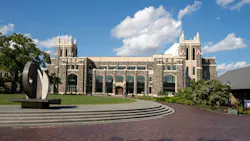
Villanova University has officially opened Vic Maggitti Hall, a $130 million, 150,000-square-foot academic building that gives its Falvey Library a new home while expanding the library’s role as a center for research, technology, student support, and collaboration. The five-story building opened on Oct. 19th at the center of Villanova’s Pennsylvania campus. Construction began in May 2024 and was completed in August.
Robert A.M. Stern Architects designed the project, and Turner Construction served as the construction company, according to Villanova University’s project fact sheet.
More than 400 students, faculty members, and staff took part in listening sessions that helped shape the building’s programming. The university says the finished facility is intended to support both traditional library functions and a wider range of academic services as the role of campus libraries continues to change.
Rev. Peter M. Donohue, OSA, PhD, ’75 CLAS, president of Villanova University, said in a press release:
“A library is the intellectual heart of a university, a place where scholarship, discovery and community come together. Vic Maggitti Hall reflects Villanova's enduring commitment to creating a learning environment where students, faculty and staff can flourish. By bringing together spaces for study, collaboration, research and innovation, Vic Maggitti Hall will strengthen the academic life of our University and foster the meaningful connections that are central to our mission.
Library combines collections with digital scholarship and student support
Falvey Library’s 400,000-volume general collection remains on site in compact, browsable shelving, while dedicated spaces provide access to rare books, manuscripts, archives, and other distinctive collections. The building also includes an expanded Digital Scholarship Suite for data visualization, text analysis, mapping, and digital media production. Audio and video production studios, recording booths, media editing spaces, and an immersive media and gaming environment support research as well as creative work.
One floor is devoted to a centralized Learning Commons that brings together academic coaching, tutoring, presentation support, exam preparation, and other student services, while a separate Research and Teaching Commons combines resources for faculty research, teaching, and scholarship.
Villanova’s approach reflects a broader shift in library planning that AS&U recently examined in its look at libraries evolving into active learning hubs. Instead of organizing facilities primarily around book storage, colleges are using library space to concentrate student services, technology, collaborative work, and different types of study environments.
More than 1,400 study seats added
Vic Maggitti Hall— named for alumnus Victor J. Maggitti Jr., whose $20 million leadership gift supported the project—provides more than 1,400 student study seats and 59 reservable group study rooms. Additionally, graduate students have access to a dedicated suite with 50 private micro-offices.
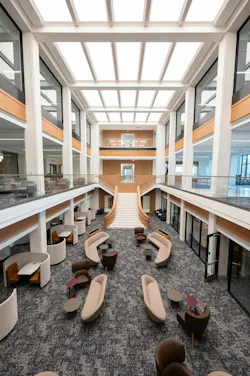
A central atrium serves as the building’s primary gathering space, while five multipurpose rooms can accommodate lectures, conferences, special events, and other university programming. The building also includes three wellness rooms for decompression, prayer, and meditation; one is designed specifically for people with sensory differences.
Falvey Library has drawn more than 500,000 visitors annually in recent years, according to the university, making the new facility a heavily used piece of Villanova’s academic infrastructure rather than simply a repository for collections.
Energy and water systems target lower operating impact
The project also incorporates several sustainability measures that are aimed at reducing long-term environmental impact and use of natural resources. Villanova says low-flow plumbing fixtures are designed to reduce indoor water consumption by more than 30% compared with the LEED baseline, saving an estimated 80,000 gallons annually. Also, a high-efficiency HVAC system is expected to help make the building 24% more energy efficient than the LEED v4 baseline.
Further, LED lighting is used throughout the facility, and materials were selected in part for low- or no-VOC emissions and environmental and health-impact disclosures. Indoor-air-quality protections also were used during construction.
Why this matters
Vic Maggitti Hall illustrates how universities are putting more functions under the library umbrella as academic needs change. Collections remain part of the program, but much of the new space is devoted to collaborative study, digital research, academic support, faculty resources, events, and student well-being.
For facilities planners, the project also shows how a major academic building can address several campus needs at once. Villanova used the $130 million investment to expand study capacity, centralize services, add technology-intensive research spaces, and improve building performance rather than treating the library as a single-purpose facility.
By adopting a broader mix of uses in one space, colleges can get more value from heavily trafficked academic environments while giving students and faculty more reasons to use the building throughout the day.