Designing Schools That Perform Beyond the Classroom
Key Highlights
- Schools like Discovery Magnet show how expressive design can support long-term performance.
- Curving masonry walls challenge conventional perceptions of mid-century institutional school design.
- Dense, high-mass materials help moderate sound and temperature throughout the school.
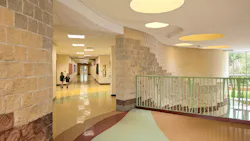

Every so often, a project arrives ahead of its time. Completed in 2011, Discovery Magnet School in Bridgeport, Connecticut anticipated many of the qualities now associated with student-centered learning environments.
From the moment you walk inside, it departs from the institutional school environments many of us grew up with, replacing them with spaces that feel open, welcoming and deeply connected to students’ daily experience.
Curving, earth-toned masonry walls guide students through the building. Split-face and ground-face block create texture and warmth. Natural light moves across surfaces designed to feel tactile and engaging rather than austere. Even before classes are in session, the building conveys something about curiosity, exploration and discovery.

Designed by Svigals + Partners, an FCA Company, the K–8 school was conceived as an environment that could support both experience and long-term functionality. That meant balancing ambitious educational goals with the realities of public-school construction: budget limitations, energy use, durability and decades of daily wear.
The project effectively challenges long-standing assumptions about what masonry school buildings can look and feel like.
Rather than relying on applied cladding and surface treatments, Discovery Magnet uses materiality as part of the architecture itself. Walls curve and unfold through common areas. Textures shift with daylight. Surfaces are resilient enough for constant use while still feeling warm and approachable.
Today’s school environments don’t have to abandon character to achieve long-term resilience.
That balance is becoming increasingly important as expectations around educational environments continue to evolve.
Designing for how students learn today
School buildings are no longer organized around static classrooms and repetitive corridors. Many now support collaborative learning, small-group instruction, hands-on exploration and flexible teaching environments that change throughout the day.
As educational models evolve, the demands placed on the building must follow suit. Noise levels fluctuate. Occupancy changes from room to room. Temperatures shift as spaces fill and empty. The ability of a school to maintain stable, comfortable conditions directly affects how students and teachers experience the environment.
Researchers at the Harvard School of Public Health described the connection between school environments and student outcomes as “unambiguous” in a 2019 report, citing evidence that factors such as acoustics, thermal comfort and overall building condition directly influence cognitive performance.
The physical environment of a school can influence more than academic outcomes alone. It also shapes whether students feel comfortable, welcomed and connected to the spaces where they spend their day.
At Discovery Magnet, those considerations influenced decisions from the earliest stages of design. Concrete masonry helped provide the durability and environmental stability needed for a high-use public school while also supporting the project’s architectural goals.
“Schools are some of the most important long-term investments a community makes,” said Heidi Jandris of Jandris Block, a third-generation member of the New England-based family business, who focuses on technical services and manufacturing innovation.
“Projects like Discovery Magnet show how concrete masonry can contribute to both performance and design. As a supplier, it’s rewarding to see materials used in ways that support learning, durability, and a stronger daily experience for students and educators.”
Acoustics and concentration
A typical school day is rarely quiet. What matters is whether the building helps control how sound moves through classrooms and shared spaces.
When sound transfers too easily between rooms, it becomes harder for students to concentrate and more difficult for teachers to maintain clear communication. Younger students are often especially sensitive to background noise and distractions.
This level of acoustic control begins with the building envelope and interior assemblies themselves. The inherent mass of concrete masonry contributes to Sound Transmission Class (STC) performance by helping moderate sound movement throughout the school.
At Discovery Magnet, that performance supports a more consistent learning environment. The goal is not silence. It is allowing students to stay focused on what is happening in the classroom rather than the activity occurring beyond it.
Durability that supports the everyday experience
School buildings experience constant wear. Corridors, cafeterias, gyms, and shared learning spaces are used and abused. When systems fail prematurely, the impacts extend beyond maintenance costs and into daily school operations.
For Discovery Magnet, durability was treated as a baseline expectation rather than an upgrade. Concrete masonry supported the project’s long-term resilience while still allowing for expressive forms, varied textures and a more welcoming educational environment.
Locally sourced CMU also contributed to the project’s LEED Gold certification, reinforcing the project’s broader sustainability goals.
When materials become part of the learning environment
Some of the most important aspects of a school building are rarely the most obvious. Thermal stability, acoustics and durability often operate quietly in the background. When those systems work well, occupants may never think about them directly. But they influence how comfortable and focused a space feels throughout the day.
There is growing recognition that successful learning environments are shaped as much by the building as the programs taking place inside it.
Here, that relationship becomes tangible. In collaboration with the Discovery Museum, students created sculptures focused on sustainability and humanity’s relationship with the environment. Those installations were incorporated directly into the masonry walls throughout the school, embedding learning and student expression into the architecture itself.

When buildings quietly do their job well
Discovery Magnet serves as a shining example of how thoughtful material decisions can deliver durability, acoustic control and long-term reliability without sacrificing character.
The best learning environments are often the ones that quietly do their job once occupied. They feel consistent. Comfortable. Reliable.
For districts, those decisions extend beyond aesthetics alone. The materials chosen today will directly shape operating costs, maintenance demands and how well a building continues serving students years from now.
Whether you’re already using CMU, considering it for the first time or exploring how the material can support long-term value in school design, my door is always open. Additional technical resources and design guidance are available at blockdesign.org.
About the Author
Chuck Rotondo is technical director for the Block Design Collective’s Northeast Region, where he works with architects, engineers and design teams on the integration of concrete masonry systems across institutional, commercial and civic projects.