The Quiet Return of Masonry in School Design
Key Highlights
- School design is evolving to balance safety, resilience and student wellbeing.
- Concrete masonry delivers passive, always-on protection built into the architecture itself.
- CMU performs multiple roles: structure, finish, thermal mass, sound control, fire and impact resistance.
- Modern design pairs masonry with glass, wood and steel to create warm, resilient learning environments.
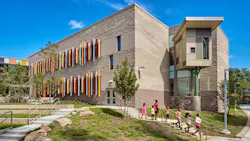

When Svigals + Partners began work on the new Sandy Hook Elementary School in Newtown, Connecticut, the job was more than simply replacing a building. The original school had been demolished following the events of 2012, and the campus was reimagined to help restore communal trust while creating a place where students and staff could feel supported and at ease.
Achieving that balance meant designing safety into the building without letting the school feel defensive or closed off.
“You don’t want to harden your entrance so much that it feels like you’re entering a prison,” says architect Jay Brotman of Svigals + Partners.
These priorities are reshaping school design in ways that simply didn’t exist a generation ago. As districts and design teams look to strike a humane balance, many are adopting Crime Prevention Through Environmental Design (CPTED) principles. At the same time, they are reexamining the critical role of high-mass materials — bringing concrete masonry back into the conversation.
Designing safety into the building
School safety conversations often revolve around procedures and technology. Cameras, training and protocols. Those tools matter. Incorporating hardened surfaces into the building itself adds another layer of protection.
Concrete masonry has been used in schools for decades because it is durable, noncombustible and structurally reliable. In many recent projects, reinforced masonry appears in the parts of the building that take the most use: corridors, classroom walls and gymnasiums. These are spaces that see constant use and must hold up over time.
Masonry walls are part of the layered security strategies used in many school designs. Properly detailed CMU assemblies can meet recognized ballistic performance standards, allowing protection to be built into the architecture rather than added later.
Durability for long-term school use
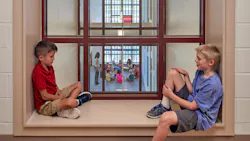
Safety is central to modern school design, and it depends on buildings that can perform reliably day after day. The steady movement of students, carts, equipment and daily operations places interior wall surfaces under constant physical stress. With lighter wall systems, those impacts often appear as scuffed surfaces, chipped corners and finishes that require patching or frequent repair. Concrete masonry quietly absorbs that daily wear.
For districts maintaining large portfolios of schools, operating budgets matter as much as construction budgets. Materials that depend heavily on applied finishes can quickly show deferred maintenance.
School construction also represents one of the largest capital investments most communities will make. These buildings are expected to serve students and communities for decades, often under tight public budgets. That long service life also matters from an environmental perspective, as durable building systems reduce the need for replacement and the embodied carbon associated with new construction.
Long-term studies reinforce that reality. A life-cycle cost analysis from the Florida Department of Education found that, for exterior wall systems, concrete masonry delivered the most favorable long-term outcomes among the systems evaluated. The analysis focused on traditional CMU assemblies and did not extend to architectural applications.
In 2025, facility assessments of 80 schools in Alberta, Canada, reached similar conclusions. Real Estate Capital Asset Priority Planning (RECAPP) facility assessment data indicate that masonry wall systems save an average of $1,536 per school per year in maintenance costs. Across Alberta’s 2,266 schools, that equates to approximately $3.48 million in annual savings, or about $261 million over a typical 75-year school service life.
For districts responsible for maintaining buildings well into the future, those differences accumulate. Over time, they become hard to ignore.
Resilient schools and community protection
School buildings often serve their communities in ways that extend beyond education. During severe weather events, campuses frequently become gathering points. They host emergency operations, voting locations and shelters when disasters disrupt daily life. That role places additional expectations on school construction.
Reinforced masonry has performed well in extreme weather conditions, particularly in regions exposed to hurricanes, tornadoes and high winds. Gymnasiums or interior masonry spaces can be designed to meet FEMA storm shelter criteria, helping protect occupants during severe storms.
A 2024 analysis from the U.S. Chamber of Commerce Foundation found that every dollar invested in resilience saves communities an average of $13 in future damages, cleanup costs and downtime.
Expanding architectural possibilities with CMU
For many people, masonry still brings to mind the plain gray block walls common in older schools. But contemporary school design also recognizes the importance of creating environments that feel welcoming and supportive.
Architectural CMU now comes in a wide range of textures, colors and shapes. Designers use fluted units, scored patterns, and recessed surfaces to introduce depth and shadow into walls.
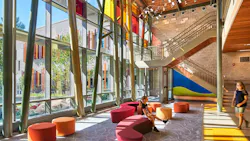
Masonry rarely stands alone in today’s schools. Architects routinely combine it with glass, wood and steel elements to create bold contrasts, added dimension and visual warmth, resulting in spaces that are equally remarkable and resilient.
Planning for long service life
Durability, resilience, and life-cycle performance are increasingly shaping how schools are planned and built. Concrete masonry aligns naturally with those priorities, offering structural reliability, long service life and the flexibility to work alongside other building systems. In many districts, that combination has brought masonry back into the conversation.
Design teams evaluating concrete masonry systems or considering how CMU performs in school design can connect with the Block Design Collective for technical guidance. The team provides a complimentary technical review of existing details and early-stage design support.
For more information, contact Chuck Rotondo at [email protected] or visit blockdesign.org.
About the Author
Chuck Rotondo is the Northeast Regional Director for the Concrete Masonry Checkoff’s Block Design Collective. In his role, he leads a team of design experts dedicated to supporting architects and engineers with tailored solutions.