New 'Comparing Campuses' report outlines 12 campus resilience strategies
Key Highlights
- The report identifies 12 key resilience strategies to guide campus planning, including embedding natural solutions and designing for system redundancy.
- Case studies from top universities demonstrate practical applications of resilience strategies, highlighting successful adaptations in diverse institutional contexts.
- Emphasizes the importance of flexible spaces, adaptable infrastructure, and community support to ensure campuses can respond effectively to disruptions.
- Highlights how decisions about space, mobility, and infrastructure can enhance campus connectivity, learning, and belonging during periods of uncertainty.
- Provides a strategic framework for campus leaders to make thoughtful, future-proof decisions that support sustainability, resilience, and institutional relevance.
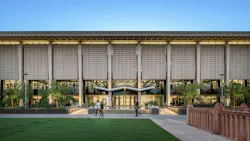
Interdisciplinary design firm Ayers Saint Gross recently released its annual Comparing Campuses research report, with this year’s edition focusing on how colleges and universities can use planning and design to strengthen campus resilience.
The 2026 report, Resilience by Design, was introduced during the Society for College and University Planning conference in Minneapolis. Now in its 28th year, the Comparing Campuses series combines research, historical analysis, and case studies to examine how campus design reflects institutional values.

This year’s report explores a wide array of timely topics facing colleges and universities today, including how these institutions can rebuild, adapt, and evolve as they respond to environmental pressures, financial constraints, social and cultural change, public health disruptions, external conflicts, and changes in teaching and learning.
Report identifies 12 resilience strategies
The report outlines a dozen strategies intended to help educational institutions make more resilient campus planning and design decisions, including:
- Embedding natural solutions
- Planning for adaptable mobility
- Rightsizing assets
- Supporting gathering and expression
- Reinvesting in and adapting existing assets
- Embedding student support in place
- Reinforcing memory and meaning
- Incorporating system redundancy
- Enabling digital and hybrid community
- Designing for cross-pollination
- Distributing critical functions
- Designing for slack
These strategies are intended to work together to serve as a planning framework for campus leaders, planners, designers, and institutional communities alike. Ayers Saint Gross notes that the research emphasizes how decisions about space, infrastructure, landscape, mobility, identity, and student support can positively affect an institution’s ability to remain connected and responsive during periods of uncertainty.
Allison Wilson, sustainability director at Ayers Saint Gross in a press release:
“Campuses have always been shaped by change, whether gradual or sudden. But when institutions invest in natural systems, adaptable infrastructure, flexible space, and places for people to find community, they create campuses that can respond to disruption while continuing to support learning, belonging, and discovery.”
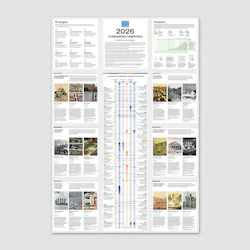
Case studies draw from campuses nationwide
The report draws on national survey data and examples from various projects across a wide range of institution types and geographies. Examples cited in the research include work at Alcorn State University, California Institute of Technology, Harvard University, Johns Hopkins University, Joliet Junior College, Michigan State University, Mills College at Northeastern University, Pennsylvania Western University, Rice University, Sewanee: The University of the South, Stanford University, Sweet Briar College, Texas A&M University, Tulane University, Union University, University of California, Berkeley, University of Chicago, and University of Virginia, among others.
Said Shannon Dowling, principal at Ayers Saint Gross:
“At a moment when colleges and universities are facing complex pressures, resilience requires both long-term vision and practical action. The strategies outlined in Resilience by Design give institutions a framework for making thoughtful decisions so that their campuses can remain relevant and deeply connected to the students, faculty, staff, and visitors they serve.”
Why this matters to AS&U readers
Campus resilience is becoming a practical planning issue, not just a sustainability concept. For higher education facilities leaders, the report points to strategies that can help institutions adapt existing assets, support student well-being, improve mobility, strengthen infrastructure, and make campuses more flexible in the face of financial pressure, climate risk, enrollment shifts, and changing academic needs.