University of Tampa is building a science center
Key Highlights
- The Science Center will have 25 teaching labs and 23 research labs supporting various scientific disciplines.
- The building will house 73 faculty offices and multiple outdoor spaces, including Riverside Garden and a green quadrangle.
- Construction begins this spring, and completion is scheduled for 2029.
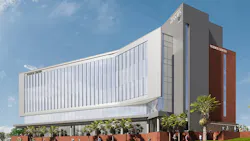
The University of Tampa will soon begin construction on a five-story, 153,000-square-foot science building in downtown Tampa, Florida.
Situated along the Hillsborough River on the university's downtown campus, the facility represents the most significant academic facility investment in the university’s 94-year history. The building will serve as the central academic hub for the College of Natural and Health Sciences and support science-based coursework across the university.
By centralizing science teaching and research spaces that are now spread across campus, the new facility will enhance connections among students, faculty and disciplines.
The Science Center will house the departments of biology and chemistry and biochemistry, along with programs in forensic science and marine science. The building will also support allied health, computational science, environmental science and other science-driven fields.
Construction is set to begin this spring, and the building is scheduled to open in 2029. Key elements planned for the Science Center:
- 25 teaching laboratories and 23 research laboratories supporting disciplines such as genetics, marine biology, anatomy, microbiology, immunology, molecular and cellular biology, biochemistry, organic and advanced chemistry, forensics and related fields
- Three microscopy rooms
- Four aquarium research laboratories
- A bioinformatics and computational sciences teaching classroom
- Two tissue culture laboratories
- An advanced instrumentation laboratory
- One 35-seat general-use classroom designed for future conversion to a 20-station instructional lab
- 73 faculty offices
The Science Center also will have three distinct outdoor spaces:
- Riverside Garden, adjacent to the West Riverwalk
- Entrance Plaza, a shared pedestrian entrance with the Grand Center and the Macdonald-Kelce Library
- Northeast Quadrangle, a green space between the Science Center and the Cass Building
The architect is HDR Architects, and the contractor is Barr and Barr.
About the Author
Mike Kennedy
Senior Editor
Mike Kennedy has been writing about education for American School & University since 1999. He also has reported on schools and other topics for The Chicago Tribune, The Kansas City Star, The Kansas City Times and City News Bureau of Chicago. He is a graduate of Michigan State University.