Building and opening a school facility represents a new beginning, and many of the decisions that have factored into the design and construction of the space will significantly affect how long the building lasts and how well it performs.
In the 1950s and 1960s, when schools and universities were adding classrooms quickly to accommodate the surging population of baby boomers, the typical design paid little attention to how long a school would last; the priority was speed and volume. Energy efficiency was not a great concern; fuel and electricity were cheap and plentiful.
As those schools aged and needed to be renovated or replaced, planners placed greater emphasis on sustainability: buildings constructed for the long term, using healthful materials, consuming energy efficiently, incorporating daylight strategies and reducing greenhouse gas emissions. The goal was to provide a productive and safe learning environment for students.
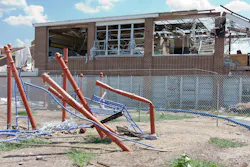
But in recent years, disruptive events like the Covid-19 pandemic and wildfires have persuaded many schools and universities to expand their view of what they should be doing to provide safe facilities and protect the students and staff in them. In short, they want their facilities to be not just sustainable, but resilient.
"Sustainability is still really important for the buildings that we design,” said Allison McKenzie, vice president and director of environmental responsibility at SHP Architecture and Design in Cincinnati. “But we're starting to see more frequent flooding, more frequent power outages, extreme temperatures—things that our buildings may need to respond to in a different way than they maybe had to even a decade ago. I think that’s the most straightforward and targeted way to view resilience in the building industry."
Tiers of resilience
To help education institutions and other clients incorporate resilience into the facilities they are building, SHP has developed a “Designing for Resilience” framework. The firm defines resilience as “the ability to prepare and plan for, absorb, recover from, and more successfully adapt to adverse events.”
“A lot of times, I like to think of resilience as helping educate our clients of what could be, not necessarily letting them rely on what has already been,” McKenzie says.
The framework is divided into six categories: hazard screening and risk assessment; site and landscape resilience; envelope and structural considerations; MEP systems and infrastructure planning; material durability and water management; and communications and documentation.
SHP’s framework has three levels of resilient design: baseline, enhanced and advanced.
Baseline: Some education institutions may not seek out resilient design; they might be more focused on cost or unaware of the benefits of resilient design. “Our strategy is to integrate resilience measures as a standard element of good design practice without requiring the client to champion it....We will meet all code requirements and add low-cost enhancements that improve resilience.”
Some of the resilient design steps at the baseline level:
- Locating building pads and critical systems above flood-prone areas
- Increasing structural wind resistance where appropriate and practical
- Designing for good thermal performance, including insulation and air tightness
- Using envelope assemblies that better manage moisture and reduce leak risk
- Protecting mechanical systems from flooding or freezing
- Incorporating daylight and operable windows to support limited functionality during outages
Enhanced: School systems at this level understand the value of resilient design to some extent...but may have budget limitations or competing priorities, so they are interested in a practical, cost-conscious resilience plan.
Resilient design measures at the enhanced level:
- Designing beyond the 100-year storm threshold
- Using landscape to mitigate wind, prevent snow drift, and shade parking and other key structures
- Structurally hardening a corridor or room to serve as a safe room
- Planning short-term backup power for critical functions
- Improving passive survivability through high-performance envelopes
- Selecting mold-resistant and water-tolerant materials in vulnerable areas
This level also involves transparent communication, including sharing hazard data, discussing risk profiles, and offering data-backed options without alarmism.
Advanced: Schools with significant interest in resilient design as a top priority or core value (school districts that see their schools as critical community infrastructure...For these projects, we embrace a comprehensive resilient design approach....design not just for the building’s survival but for it to actively support the community during and after adverse events.
Strategies may include:
- Integrating code-compliant storm shelters
- Designing to higher structural importance factors
- Installing sensors and alarms for water intrusion
- Providing comprehensive emergency power systems capable of extended operation
- Incorporating renewable energy and battery storage
- Designing for rapid damage assessment and recovery
These strategies can ensure that a building won’t just survive a catastrophic event but can actively support the community in the aftermath, SHP says.
Survive and move ahead
Resilient design will help an education facility withstand the fallout from a catastrophic event and put it in a position to recover.
For maintaining operations after a negative event, there are three main categories of strategies, Mc Kenzie says: redundancy, modularity and passive survivability.
Redundancy: Having an additional mechanical unit or heat pump will enable a facility to continue operating if the first system has been disabled.
Modularity: “That might mean instead of designing for one large air handler for the building, you've designed two,” McKenzie says. “So if one gets taken out, certainly you can't maintain full comfort in the building, but you still have one able to maintain comfort and operations in at least part of the building.”
Passive survivability: “These are kind of your age-old strategies,” McKenzie says. “Are your windows operable? Can your building maintain heat and cool on its own through a good thermal envelope? Do you have daylight? Are there windows so that if the power is out you can still have some natural lighting in the building?”
Managing risk
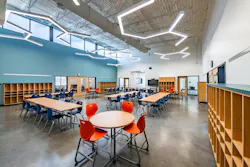
SHP incorporated resilient design strategies in its work on the Dayton Regional STEM Elementary School, which opened earlier this year in Kettering, Ohio. It was built on a site adjacent to the existing Regional STEM high school, but much of the site was in a floodplain.
“It was really important to site the building to make sure that it stayed well out of the floodplain so we could ensure that it wouldn’t have any water damage issues or have any threats to occupancy during rain events,” McKenzie says.
To account for changing weather patterns that may have made 100-year floodplain maps out of date, the school design included enhanced flood protection
“We’re seeing rainfall events that are faster and with more quantity of water than we have in years past,” McKenzie says. “So we stepped it up above what FEMA flood maps may have shown us as a good base flood elevation.”
The flood protection in the design made it possible for wetlands and a pond to be situated near the school and used as a teaching tool.
“This is successful project where we had a significant risk to the building through flooding and high-volume storm events, but we were able to not just mitigate the risk but really embrace it for the school.,” McKenzie says.
=======================================
[sidebar]
Addressing climate risks
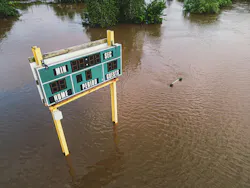
Extreme weather is increasing in frequency and severity, according to SRI Education, a nonprofit research institute. A report from 2025 states that nine out of 10 school districts experienced at least one extreme weather event from 2010 to 2020. It found that 79% of districts experienced a storm strong and destructive enough to receive a federal disaster declaration between the 2010-11 and 2019-20 school years.
To help schools prepare their campuses to avert or mitigate problems brought about by extreme weather, the Center for Green Schools has compiled a list of steps to address different types of weather events
Wildfires: The priorities are to minimize the exposure of occupants to harmful contaminants in the air and to minimize the damage to property. Some possible steps:
• Upgrade to MERV 13 filters in ventilation systems and use portable HEPA air cleaners.
• Weatherize buildings and repair windows and doors to minimize smoke infiltration.
• Explore wildfire-resistant, noncombustible building materials
• Create a fire-resistant zone around the perimeter of schools.
• Install indoor air quality sensors to monitor fine particulate matter.
Extreme temperatures: Ensure that the building and grounds are protecting occupants as effectively as possible. Some possible steps;
• Weatherize buildings and repair windows and doors to minimize outdoor air infiltration.
• Reduce heat gain across the building envelope with “cool” reflective roofing, increased roof insulation and exterior window shade structures.
• Choose “cool” pavements with higher solar reflectivity values.
• Install ceiling fans and provide portable fans where existing ventilation is insufficient.
• Evaluate ventilation systems to identify under-performing or at-risk equipment.
• Increase shade in outdoor spaces by installing shade structures and planting trees.
• Use drought-resistant, native landscaping and minimize irrigation.
Hurricanes, flooding and storms: Preparing for water and wind damage involves assessing flood levels and mitigating potential damage to critical systems. Some possible steps:
• Evaluate site modifications to reduce exposure to flood waters, including fills, levees, and floodwalls. Improve stormwater management using bioswales, permeable pavement and rainwater collection systems.
• Update design flood elevation levels at or above the historical high-water mark for new construction and major renovations.
• In spaces below flood levels, replace water-sensitive materials such as drywall with water-resistant materials like concrete and tile. Where possible, move critical HVAC and electrical equipment above flood levels.
• Ensure roofing materials are rated for wind and impact resistance, and secure rooftop mechanical equipment with additional fasteners.
• Document building conditions pre-flood/storm for insurance purposes.
Power outages: The most critical goals are those associated with life safety; continuity of school operations runs a close second. Some possible steps:
• Install back-up on-site power generation, particularly solar PV arrays and battery storage that can operate off-grid. Ensure that all critical life safety equipment, like smoke and carbon-monoxide detectors, have back-up power or charged back-up batteries.
• Prepare for the impact to school food programs in the event of lost power, including transporting, storing and serving meals.
• Verify backup communications methods with emergency responders, staff and parents.
About the Author
Mike Kennedy
Senior Editor
Mike Kennedy has been writing about education for American School & University since 1999. He also has reported on schools and other topics for The Chicago Tribune, The Kansas City Star, The Kansas City Times and City News Bureau of Chicago. He is a graduate of Michigan State University.