As winter turns to spring each year, rising temperatures and the blooming flowers may prompt many students to daydream of escaping the confines of their classrooms for the excitement of the great outdoors.
Schools recognize that the outdoors are more than just tempting distractions for students—they can be effective learning environments. That became clear in 2020 when Covid-19 made it impossible for normal instruction to continue. The pandemic led many schools to use outdoor spaces to combat school closures and provide the physical distancing required to meet health and safety guidelines.
“Moving programs outside helped school districts across the country to stay open through the Covid-19 crisis, and many found the experience so rewarding that they decided to keep part of the school day outside permanently,” Green Schoolyards America says.
So what should schools include in their outdoor learning spaces? The Geneva Point Center, a nonprofit camp in New Hampshire has some ideas. It has compiled “The Complete Guide to Outdoor Classrooms.”
“Research consistently demonstrates significant improvements in student engagement and academic performance in outdoor settings,” the guide asserts. “Studies show that children in outdoor learning environments exhibit enhanced attention spans, improved memory retention, and increased creativity compared to their indoor counterparts. Additionally, students participating in outdoor education programs demonstrate better physical health, including improved vitamin D levels and reduced rates of respiratory illnesses.”
Here are some of the center’s recommendations.
Seating: Schools should consider weather-resistant seating that can accommodate various group sizes and teaching configurations. Possibilities: Log circles blend seamlessly with outdoor environments and support discussion-based activities. Stone benches offer permanent seating that require minimal maintenance. Portable seats allow for flexible arrangements based on specific lesson needs and weather conditions.
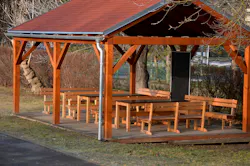
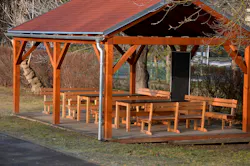
Covered areas: These make year-round outdoor learning feasible. Pavilions provide substantial shelter for larger groups and protect educational materials from precipitation. Pergolas offer partial coverage that maintains connection to the outdoor environment while providing shade and weather protection.
Storage: Schools must balance accessibility with weather protection to ensure educational materials remain functional and organized. Weatherproof cabinets protect sensitive equipment such as scientific instruments, books and art supplies from moisture and temperature fluctuations. Tool sheds provide secure storage for larger items.
Building materials: Natural building materials enhance the authentic outdoor feel of a space and provide durability with minimal maintenance. Logs serve multiple purposes: seating, work surfaces, and natural climbing structures that encourage physical activity. Stones create permanent pathways, seating areas, and natural boundaries between different learning zones. Bamboo offers sustainable material options for screens, trellises and lightweight construction projects that students can participate in creating.
Safety: Schools need to thoughtfully integrate safety features into outdoor classroom design without compromising the natural aesthetic. First aid stations should be accessible but protected from weather exposure. Clear sight lines throughout the space enable teachers to supervise all students effectively while maintaining the open, natural feel of the environment. Access to emergency communication, including cell phone signal boosters or landline connections, provides essential safety infrastructure.
Gardens: These spaces form the foundation of many outdoor classrooms. They provide living laboratories for botany lessons and environmental science exploration. Vegetable gardens offer practical applications for plant biology, nutrition education and sustainable agriculture practices. Native plant areas create opportunities to study local ecosystems and support biodiversity and conservation. Butterfly gardens attract pollinators and provide excellent subjects for observing insect life cycles, plant-animal relationships, and seasonal changes.
Water features: These enhance the educational value of outdoor classrooms through hydrology and ecology studies. Rain gardens demonstrate water conservation principles and create habitats for various plant and animal species. Ponds support aquatic ecosystem investigations and enable students to carry out year-round observations of water quality, aquatic life and seasonal environmental changes.
Weather monitoring stations: These transform outdoor classrooms into functional scientific research facilities. Thermometers enable daily temperature tracking and documentation of seasonal climate patterns. Rain gauges provide data for math applications like measurement, graphing and statistical analysis. Wind measurement tools support meteorology studies and help students understand weather system relationships.
Outdoor libraries: Literacy development flourishes in natural settings where students can connect reading with real-world experiences. Weatherproof book storage protects literary materials and provides easy access during outdoor lessons. Reading nooks created with natural materials provide quiet spaces for independent reading and reflection. Many outdoor libraries incorporate themes related to nature, science and environmental literature that complement outdoor learning.
Art and creativity zones: Natural environments can inspire artistic expression and creative development. Easels positioned to capture natural lighting support outdoor painting and drawing. Natural material collections, including leaves, stones, and branches, provide resources for sculpture, craft projects, and seasonal art activities.
Science investigation areas: These spaces enable students to take part in hands-on scientific inquiry and exploration. Magnifying equipment enables detailed observation of plant structures, insect characteristics and geological specimens. Specimen collection tools support field research and encourage systematic scientific observation. Observation journals help students document their discoveries and develop scientific writing skills while compiling records of environmental changes and seasonal patterns.
About the Author
Mike Kennedy
Senior Editor
Mike Kennedy has been writing about education for American School & University since 1999. He also has reported on schools and other topics for The Chicago Tribune, The Kansas City Star, The Kansas City Times and City News Bureau of Chicago. He is a graduate of Michigan State University.