An Industry in Demand
By Mike Behrmann, Lori Everett and Cory Kamholz
To remain relevant and successful, colleges and universities continue to adapt to the needs of students and the workforce demands of their surrounding communities. Community colleges in particular share a mandate to support educational training and job readiness that meet the needs of a quickly changing occupational landscape. Automotive and diesel technologies are industries undergoing rapid change as technicians adapt to highly sophisticated electric vehicles and internal combustion engines that pair with fuel-saving technologies, camera and sensor support, self-driving capabilities and other emerging innovations.
There is a growing shortage of technicians with the knowledge and skills to keep vehicles operational. Many higher education institutions (including St. Louis Community College, Olive Harvey College in Chicago, and Southern Illinois University Carbondale) have made investments in technology-rich, hands-on learning environments designed to attract and train the next generation of workers.
The numbers don’t lie: The TechForce Foundation’s 2024 Supply and Demand Report predicts that over the next five years, nearly 1 million entry-level transportation technicians will be needed in the automotive, collision, diesel and aviation industries. Transportation education environments must align with the needs of the evolving automotive industry and support the learning styles of Gen Z students and returning students looking to upskill. As the industry integrates more sophisticated technologies that support electric and hybrid vehicles, navigation systems, and autonomous and semi-autonomous vehicles, the automotive field offers an opportunity for students interested in hands-on, problem-solving environments that incorporate new technologies and evolving skills.
Exceptional automotive learning space design enhances student recruitment and retention, delivers a high-quality educational experience and builds social communities on campuses.
Designing transportation learning spaces
Transportation learning spaces that are clean, high-tech, hands-on, sustainable and replete with opportunities for collaboration bring academic programming to life.
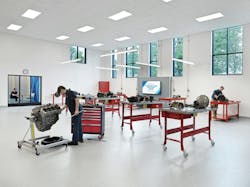
An automotive lab in an academic setting is more laboratory than workshop. Today’s high-tech laboratories are clean, organized and well-lit environments that optimize the use of natural light and offer appropriate storage for tools, parts and equipment. Safety is an important consideration; providing ample maneuvering clearances, well-marked and obvious pathways for carts, mobile lifts and vehicle traffic, and readily available and adequate storage keep a space neat and limit accidents. The laboratories at Southern Illinois, St. Louis Community College and Olive Harvey all have high ceilings, windows around the perimeter, a bright and clean color palette, and multiple connections to adjacent learning spaces.
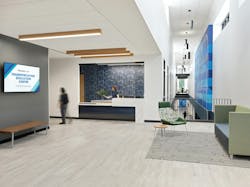
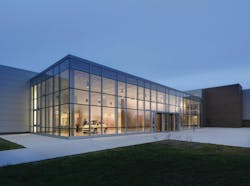
Although hands-on learning is evident in every room, one of the design considerations that makes these facilities effective is the use of transparency. The Transportation Education Center building at St. Louis Community College has a multistory link that brings natural light to the lower level. Alongside the link are informal student gathering areas with views through dedicated, hands-on classrooms into the larger automotive labs beyond.
Visual connections from one space to another and to their surrounding environments create dynamic learning environments. Prospective students can see learning on display and connections between specialized labs, classroom spaces, study areas and places for respite. These visual links can reinforce educational connections, improve safety and support community building.
Designed for Change
Because the technologies that power vehicles are changing at a rapid clip, these educational spaces must be equally adaptable and future-ready. Technologies like augmented reality or virtual reality, new electric vehicle platforms and battery types, advancements in autonomous driving, and other innovations are all likely to affect learning in the coming years. Offering a flexible layout with access to adequate power and data infrastructure can support adaptability as needs change.
Automotive training also may be enhanced by supporting a variety of multimodal learning styles and educational technologies. Many of these facilities make use of a “flipped” classroom where students perform problem-solving tasks in class and absorb lecture information at their own pace outside the classroom. The new laboratories at St. Louis Community College use a combination of cameras and monitors to support a variety of learning platforms. Similarly, Southern Illinois supports hybrid and remote learning by incorporating flexible broadcasting suite technologies that embrace a variety of media solutions.
Resilient and Sustainable
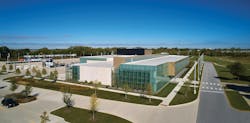
Just as the automotive industry moves toward more efficient vehicles and embraces technologies that limit the use of fossil fuels, these corresponding educational spaces also are excellent platforms for a variety of sustainable design considerations and technologies. Those include access to natural light and views, improved thermal envelopes, energy recovery, and other sustainable heating and cooling options. The design for Olive Harvey incorporates a planted “green screen” that reduces solar heat gain and a rooftop transpired solar collector that's part of the building’s HVAC system. The solar collector is a low-tech, black surface that heats quickly in the sun and uses that heat to warm the fresh air that will replace exhaust during Chicago winters. New generations of students continue to seek cleaner, healthier environments, and automotive technology projects can meet that demand.
Fostering Campus Community
Every building that supports education should be designed to promote collaboration and a sense of belonging among students. Some automotive programs have students work in the community as part of their program curriculum, making it challenging to invest time on campus. Design plays a critical role in shaping the learning culture of a training program and influences a student’s feeling of belonging. Going beyond learning support, a facility designed with community in mind can stimulate student interest, support faculty and student engagement, and foster industry and academic collaboration.
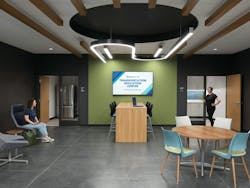
Wellness rooms, informal collaboration areas, breakout spaces and student lounges with access to vending or a café support student connections and encourage a healthy, collegial culture. St. Louis Community College, Olive Harvey College and Southern Illinois University each have ways of moving engines and vehicles out of lab and classroom spaces into and alongside larger student gathering areas so the spaces can accommodate large events. Direct access to vehicles and equipment and views into surrounding classroom and lab spaces enable such events to remain connected to student work and celebrate the learning taking place.
Well-designed automotive technology buildings provide many opportunities to support a college’s educational mission, recruit students to a high-tech field with excellent career potential, celebrate sustainable design, enhance feelings of belonging among students, and put learning on display.
Mike Behrmann, Emeritus Associate Dean, Southern Illinois University Carbondale, has over 40 years of experience in the automotive, truck, and academic industries.
Lori Everett, AIA, NCARB, LEED AP is a Principal with FGM Architects and a Higher Education Regional Market Sector Leader.
Cory Kamholz, AIA, LEED AP is a Design Principal with FGM Architects and has 25 years of experience designing higher education projects.