Private colleges increase tuition discounts as financial pressure grows
Key Highlights
- Tuition discount rates for first-time undergraduates reached 57.1% in 2025, indicating heavy reliance on institutional grants.
- Approximately 90% of first-year students and 84% of all undergraduates received institutional aid, reducing the impact of sticker prices.
- Most institutions are implementing new retention strategies to boost net revenue, including expanded financial aid and recruitment efforts.
- Net tuition revenue declined by around 2% between 2023-24 and 2024-25, creating financial pressures on campus facilities and investments.
- Retention efforts are increasingly viewed as both a student success and financial strategy to sustain institutional stability.

Private nonprofit colleges and universities continue to rely heavily on institutional grants to offset the published cost of tuition, according to new research from the National Association of College and University Business Officers (NACUBO).
The 2025 NACUBO Tuition Discounting Study, which includes responses from 258 private nonprofit colleges and universities, found that estimated tuition discount rates for the 2025-26 academic year reached 57.1% for first-time, full-time undergraduates and 51.3% for all undergraduates.
In practical terms, that means participating institutions awarded about 57 cents in grant aid for every dollar of tuition and fees they could have charged first-time undergraduates, and about 51 cents for every dollar across all undergraduates receiving institutional aid.
Figure 1: Average Institutional Tuition Discount Rate, by Student Category
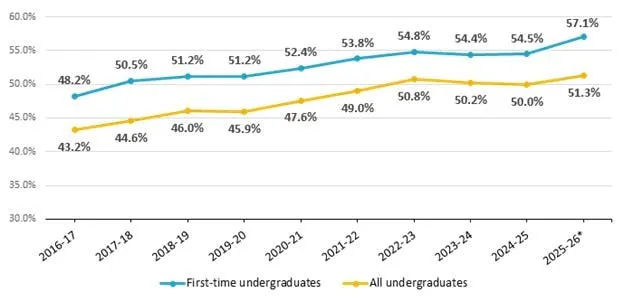
The study also found that most students at these institutions receive grant aid. About 9 in 10 first-time, first-year undergraduates received institutional grants this academic year, as did 84% of all undergraduates.
For college and university leaders, the findings point to a continued gap between published tuition prices and the net prices students actually pay. NACUBO President and CEO Kara D. Freeman said in a statement: “The data tell a clear story: Don’t rule out a private college due to its sticker price, because odds are very good that you will receive a grant from that school. Private colleges and universities are working hard to put postsecondary education in reach for all undergraduates, so it is worth applying for financial aid to find out your own net price of college.”
The study also highlights how tuition discounting intersects with broader enrollment and financial challenges. More than half of institutions surveyed—57.1%—reported new retention efforts for current students as a strategy to increase net tuition revenue, making retention the most commonly cited approach.
Figure 2: Percentage of Institutions That Planned New Strategies to Increase Admissions, Enrollment, or Retention in FY26, by Strategy Type
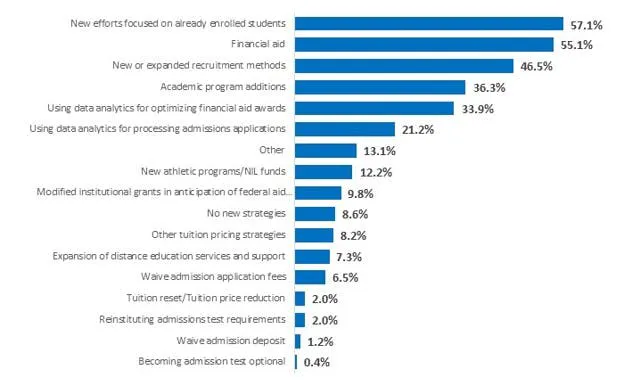
Other strategies included financial aid, new or expanded recruitment methods, academic program additions, and the use of data analytics to optimize financial aid awards.
Retention is becoming a financial strategy as much as a student success strategy. Freeman noted that helping students persist to graduation benefits students while also supporting institutional financial stability.
The pressure remains significant. NACUBO reported that inflation-adjusted net tuition and fee revenue declined between 2023-24 and 2024-25 by 2.2% per first-time, full-time undergraduate and 1.9% among all undergraduates.
Why This Matters
Tuition discounting affects institutional revenue, enrollment strategy, capital planning, and long-term campus investment. If colleges are relying more heavily on grants while net tuition revenue declines, facilities leaders may face tighter budgets, delayed capital projects, greater scrutiny of deferred maintenance, and increased pressure to align building investments with recruitment, retention, and student success goals.