construction zone | cafeteria/food service facilities
New central kitchen provides meals for New Bedford schools
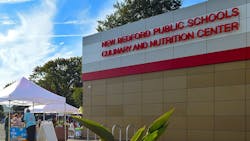
The New Bedford (Massachusetts) district has opened a $14 million central kitchen in a renovated 1930s facility.
The 17,000-square-foot Culinary and Nutrition Center began operations in summer 2025.
The building was constructed as a car dealership in the 1930s, according to Habeeb & Associates Architects. The district gutted and repurposed the space to accommodate large-scale food preparation, storage, and other logistics of food service.
The architect describes the facility as "the culinary epicenter of all of New Bedford's public schools," as well as child-centered non-profits, parochial schools, and other local organizations. It will prep and cook meals for 49 locations.
“The new Central Kitchen will allow us to deliver better meals to students more efficiently and consistently across the district,” Mayor Jon Mitchell said. “A strong foundation in nutrition is essential for students to succeed in the classroom.”
The center has a 1,218-square-foot refrigerated food preparation area where foods can be prepackaged for reheating or prepared in single-serve packaging; a 1,170-square-foot walk-in cooler with space for 44 pallets of food supplies; a 1,751-square-foot walk-in freezer with space for 68 pallets of frozen goods; a blast cooler to quickly lower food temperature; a blast freezer to quick-freeze prepared foods; a storage area with space for 65 pallets of dry goods: a commercial cook kitchen featuring 40-gallon tilting skillets, 80-gallon kettle and high-efficiency combination ovens; a loading dock for commercial and visitor and staff parking.
The district used $9.2 million in federal Covid relief funds, as well as U.S. Department of Agriculture money, to help pay for the facility.
Food hall opens at University of Tennessee
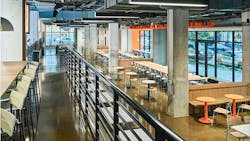
University of Tennessee, Knoxville, has opened Cumberland Food Hall, a new dining facility on the first floor of Hub Knoxville, a multitower community that houses nearly 2,000 students.
The university held a ribbon-cutting ceremony in November to mark the grand opening of the space, which was built in partnership with private developers. The hall has seating for nearly 350 people and was developed to serve students living off campus and the broader Knoxville community.
It has four unique dining options and a ghost kitchen, in which multiple brands are prepared and shared from the same kitchen space. The technology-driven design enables guests to order from several dining concepts through an app or at kiosks. Meals are placed into secure lockers for easy pickup.
A variety of foods are available in the hall’s four dining concepts:
Athenian Grill, serving Mediterranean bowls and gyros made with halal meats and offering customizable fresh flavor options
A second location of the Big Orange Grill, a partnership with UT’s Northeast Tennessee AgResearch and Education Center offering fresh smashburgers and fries made with locally sourced ingredients
South Street Steaks, specializing in Philadelphia-style cheesesteaks and loaded fries
Zen Sushi & Wok, featuring authentic and freshly made sushi, ramen, wok dishes and bubble teas
“We are excited to open this beautiful, innovative space where the Vol community can come together and enjoy delicious meals just off campus,” said Amanda Hough, director of Vol Dining. “Cumberland Food Hall truly reflects our commitment to creating dining experiences that bring people together.”
Kitchen facility under construction in the Buffalo (N.Y.) district
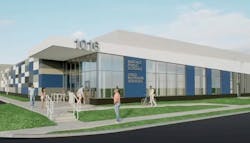
Construction has begun on a $44 million commissary kitchen for the Buffalo (New York) school district.
WGRZ-TV reports that the 61,000-square foot facility is being built across the street from the district's existing food production site and is expected to open in spring 2027. It will have a large production kitchen, a community room and a test kitchen to train new staff.
The project has been in discussion for more than a decade. Lou Petrucci, chief operating officer for Buffalo Public Schools, says the new facility will support farm-to-table operations and give the district the space to accept more New York state-grown products.
The upgraded commissary will be about 18,000 square feet larger than the existing one. Plans include a training kitchen, multipurpose community room, and modern cook-and-chill technology. Officials also highlighted the improved ingress and egress design that will enable trucks to move in and out of the site more efficiently and safely.
The architect is Kideney Architects, and the construction manager is Buffalo Construction Consultants.
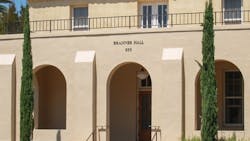
Allergen-free dining at Stanford
Stanford University is now offering allergen-free dining in one of its dining halls.
The university says that since fall 2025, Stanford's dining facility in Branner Hall has been providing students meals that are free of the nine most common allergens: milk, eggs, peanuts, tree nuts, soy, wheat, fish, shellfish, and sesame.
“Our goal in this residential dining program is to have a safe and secure environment for all students to eat, particularly those with complex food allergies,” said Eric Montell, assistant vice provost of Stanford Dining, Hospitality, and Auxiliaries.
Montell says an increasing number of students at Stanford are reporting complex food allergies, particularly to peanuts, tree nuts, wheat, gluten, milk, and shellfish.
The Branner dining hall has food stations and daily specials like the others on campus; however, the menu has been modified to accommodate those with allergies. Branner’s hamburger buns don’t contain wheat or milk, the pizza crust has no dairy, the pesto has no nuts, and the cheese is coconut-based.
“We’re mirroring the cuisines offered at other dining halls, but removing or substituting ingredients,” says Jay-Ar Pugao, a Stanford dining chef.
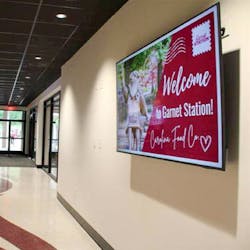
Garnet Station is the newest dining hall at University of South Carolina
The University of South Carolina in Columbia has opened its newest on-campus dining hall, Garnet Station.
The dining hall is on the first floor of the Russell House University Union and has over 500 new student dining seats, both indoor and outdoor. In total, almost 21,000 square feet of space was renovated, and an additional 8,450 square feet of kitchen space was added to accommodate various food options: a grill, home cooking, an international and pasta station, a pizza station, a salad bar and deli, and a dessert and coffee station.
“One of the things we heard in our conversation with students was the need for more dining and seating options at the center of campus,” says Joe Fortune, director of business affairs and contract management. “This facility not only provides both of those things but also incredible food options.”
began in May and was completed on an aggressive three-month timeline to open before classes start Aug. 19.
Garnet Station also has a true balance station to serve food without the top nine allergens for diners with dietary restrictions.
The addition of Garnet Station gives South Carolina students six dining halls with unlimited dine-in access.
“This is a place where students will gather between classes, where faculty and staff will share ideas over lunch and where lifelong friendships will begin,” says Joe Sobieralski, senior associate vice president for administration and business affairs.
The project is a partnership among the university, Aramark, Hood Construction and the Garvin Design group.
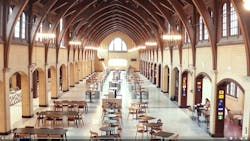
Landmark cafeteria at Mississippi State gets $30 million renovation
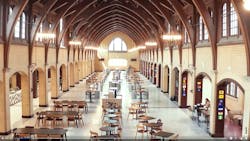
Mississippi State University in Starkville has renovated its century-old campus cafeteria and reopened it as a new dining destination called Perry Food Hall.
The university says the $30 million project has upgraded the campus landmark while still honoring its storied past.
“Perry is one of our most iconic buildings—it’s what many people think of when they picture Mississippi State University," University President Mark E. Keenum said. "This renovation preserves that history and builds on it to create a truly special space and unique experience."
Built in 1921 and once the largest cafeteria in the nation, Perry has long been more than a place to eat. As one of Mississippi’s officially registered landmarks, its Late Gothic Revival architecture remains on display with its exposed timber beams and nostalgic charm anchored in the heart of campus.
At the center of the transformation is 1921 Café—a nod to Perry’s founding year—where Southern comfort food meets Bulldog traditions. Bark, a smokehouse-inspired venue, serves slow-cooked barbecue. The Beet Drop offers build-your-own salads and plant-based meals.
“The renovation and re-opening of Perry marks an exciting new chapter for our campus,” Vice President of Student Affairs Regina Hyatt said. “This beautifully reimagined space not only enhances the dining experience with more options and flexibility, but also creates inviting places for students and the MSU community to gather.”
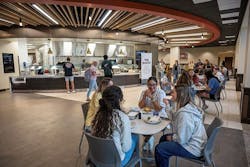
New dining hall is part of University of Wyoming's largest construction project
The North Residence Hall and its two-story Dining Center opened to students at the University of Wyoming in Laramie for the fall 2025 semester.
The two-story Dining Center -- with nine serving stations that will cater to students, faculty, staff and Laramie residents -- should become a hub for campus life, says Eric Webb, the university's associate vice president for business enterprises.
“After years of planning, design and construction, this new housing and dining facility isn’t just a building--it’s a better way to live, learn and connect on campus,” Webb says.
Nine food stations provide a wide range of culinary options--burgers, salads, Italian, Asian, South American.
“We want to welcome not just our new students, but all of campus and Laramie to what we think is going to be a wonderful dining experience,” says Vaishali Parag Chitnis, associate director of Dining Services.
The dining hall, North Residence Hall and South Residence Hall, which is scheduled to open in 2026, comprise the largest construction project ever on the University of Wyoming campus--$285.5 million.
“The addition of the new residence halls and Dining Center makes UW an even more wonderful place for Wyoming students to further their education,” says Kermit Brown, chairman of the university's Board of Trustees. “They provide a healthy and stimulating living environment conducive to success at the college level.”
Funding for the project came from $205.8 million in bonds issued by the university, supplemented by about $80 million in legislative appropriations.d
West Texas A&M dining hall reopens after a $3 million renovation
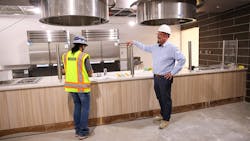
The dining hall at West Texas A&M University in Canyon has reopened following a $3 million upgrade.
The university says the Caf, as the facility is commonly known, has a completely redesigned layout with upgraded equipment, as well as an expanded menu offering personalized options at six entrée stations.
The entrée stations each feature modern equipment designed to cook in smaller batches, ensuring fresher, higher-quality food. A standalone grill station will allow for shorter wait time, and the True Balance station, which provides meals free from the top nine allergens, is now fully separated to reduce cross-contamination.
A new food lab and teaching kitchen enables chefs to offer culinary demonstrations for students, with rotating food concepts each semester. The teaching kitchen also will offer an expanded late-night menu.
Renovations began following the conclusion of the spring semester. Workers demolished an old serving line, equipment, flooring and wall finishes. In the interim, food service was housed in the attached Alumni Banquet Hall.
Phase III of the cafeteria project is scheduled to begin in summer 2026 and will include renovations to the upstairs dining space, the addition of an elevator and updates to the main entrance.
By the completion of the final phase, more than $6 million will have been invested in improvements for The Caf since 2024.
Central kitchen opens for schools in Kern County, California
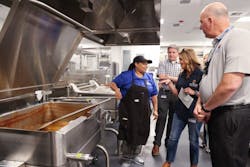
The Kern County (California) Office of Education has opened a new central kitchen.
The Kern County Superintendent of Schools office says the 6,435-square-foot facility replaces the former kitchen housed inside the Richardson Child Development Center.
That original space was designed to serve about 1,000 meals a day, but eventually was pushed beyond its limits, producing more than 6,000 daily. The new facility not only meets existing demand but also future growth; it can be expanded up to 10,000 square feet if needed.
“We’ve always made it work with what we had, but this facility gives us the tools to truly grow,” Food and Nutrition Services Director Rafael Juarez said. “It’s going to allow us to reach more students, experiment with new recipes, and provide better support to schools and programs countywide.”
John Mendiburu, Kern County Superintendent, said the central kitchen is also a meaningful investment in student success.
“Healthy meals lead to healthy students, and healthy students tend to do better in school,” said Mendiburu.
Juarez says that with the expanded facility and updated equipment, the department has grown to over 40 employees. He hopes the central kitchen will continue evolving into more than just a place where meals are made. He envisions it as a hub for culinary education, student empowerment, and deeper community partnerships.
With plans to collaborate with microproducers, and engage students through cooking demonstrations and tastings, Juarez sees the kitchen as a launchpad for healthier habits and stronger connections.