Enhancing School Indoor Air Quality: Strategies for Better Ventilation and Daylight
Key Highlights
- Classrooms often operate at higher occupant densities, increasing the demand for effective ventilation and air quality management.
- Filtration systems like HEPA filters reduce particulate matter but do not address CO2 levels or humidity, necessitating additional ventilation solutions.
- Natural ventilation strategies, such as skylights and operable windows, can enhance airflow and reduce reliance on mechanical systems, especially in older buildings.
- Hybrid ventilation approaches, combining natural and mechanical methods, outperform single systems in reducing pollutants and maintaining stable indoor conditions.
- Integrating daylighting with ventilation not only improves indoor air quality but also boosts mood, concentration, and potentially student performance.
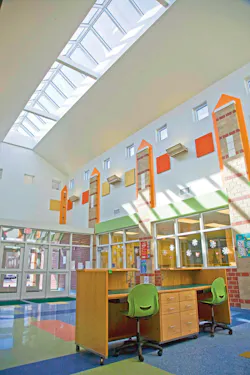
Indoor air quality has moved from a background issue to a top priority for many school districts. Aging buildings, higher occupancy levels and rising expectations around health and performance are putting pressure on facilities to do more with systems that weren’t always designed for today’s demands. Because of this, many schools continue to fall short in air quality, daylight and thermal comfort.
In particular, classrooms are challenging environments. According to the U.S. Environmental Protection Agency, classrooms typically operate at much higher occupant densities than offices, sometimes several times higher. That puts additional strain on ventilation systems. At the same time, indoor pollutant levels can be two to five times higher than outdoor levels, and many schools struggle to meet recommended ventilation rates because of aging equipment or maintenance limitations.
The effects show up quickly. Poor indoor air quality is associated with drowsiness, headaches and reduced concentration. According to the U.S. Department of Education, classroom environmental conditions may account for up to 16% of differences in student learning progress. For school planners, facility decisions affect comfort, as well as attendance, system performance, and how well a building supports its occupants.
Limits of filtration
Filtration has become the go-to solution in many schools, especially in recent years. High-efficiency particulate air (HEPA) filters can make a measurable difference; studies show reductions of roughly 30% to 40% in airborne particulate matter in classroom settings.
But filtration has its limits. It captures particles, but it doesn’t bring in fresh air. It doesn’t reduce carbon dioxide. It doesn’t address humidity. All of these factors shape how a space actually feels and performs over the course of a school day.
There’s also a practical constraint. In crowded classrooms, filtration alone often can’t keep up with how quickly pollutants build up. That’s why more schools are starting to look beyond filtration as a standalone fix.
Ventilation basics
Ventilation, at its core, is about replacing stale indoor air with fresh outdoor air. Mechanical systems handle much of that work, but building design also can play a meaningful role.
One of the simplest ways to support airflow is through the stack effect. Warm air rises. When it has a path to escape through a high opening, it moves out of the building, pulling cooler air in behind it.
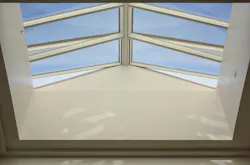
This is where skylights come into play. Because they sit at the highest point of a building envelope, operable skylights create an effective release point for warm air. As that air exits, it draws fresh air in through windows or other openings lower in the space. The result is a steady flow of air without relying entirely on mechanical systems.
In classrooms with windows on only one side, which is common, this kind of vertical airflow can make a noticeable difference. Without it, air tends to stagnate. With it, spaces feel more stable and well ventilated.
A hybrid approach
Rather than choosing between mechanical systems and natural ventilation, some schools are starting to use both. The two approaches solve different problems, and together they tend to perform better.
Ventilation helps move air through a space, diluting pollutants and lowering carbon dioxide levels. Filtration captures particulate matter that ventilation alone won’t remove. Used together, they create a more complete system.
Pairing operable windows with roof-level openings, including operable skylights, can speed up how quickly stale air is replaced. Research comparing ventilation strategies has found that hybrid systems often outperform mechanical-only setups when it comes to air exchange and carbon dioxide reduction. Additionally, smart skylight systems can be set up to automatically open when indoor carbon dioxide or humidity levels become too high.
For older buildings, this approach can be especially useful. Adding or improving natural ventilation doesn’t require the same level of investment as replacing an entire HVAC system.
Daylight dividend
Ventilation and daylight tend to go hand in hand. When a building is designed to bring in fresh air, it often brings in more natural light as well.
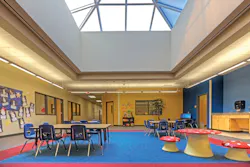
Skylights play a unique role here. Light from above reaches deeper into a room than light from vertical windows; this can make a space feel brighter and more open. In classrooms, that matters. Natural light has been linked to improved mood and concentration, and some studies suggest it may contribute to gains in student performance, with increases of up to 15% reported in certain environments.
There are operational benefits, too. More daylight during the school day can reduce the need for artificial lighting, which lowers energy use and helps manage long-term costs.
Taken together, ventilation and daylighting strategies can address multiple aspects of indoor environmental quality at once, rather than tackling each issue separately.