Hot water, hidden costs
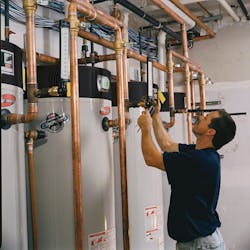
As schools and universities head into 2026, they face many acute challenges. These challenges aren’t just confined to academics or enrollment; campus facilities themselves pose a number of pain points. Facilities teams may find themselves torn between the realities of rising energy costs and aging infrastructure on one hand, and increasingly aggressive efficiency and sustainability goals on the other.
When strategizing about how to balance these competing priorities, facilities teams often emphasize factors like HVAC systems and campuswide lighting. All too often, water heating systems are left out of long-term planning efforts, despite having a major effect on school energy consumption.
Water heaters play a role in basically every campus function; they ensure comfort in residence halls, hygiene and efficiency in the dining area, and effective daily operations within science labs and athletic facilities. Facilities teams that are serious about campuswide energy policies will want to evaluate, optimize and future-proof hot water systems for efficiency, reliability and cost control.
Water heaters matter
It’s difficult to exaggerate how much water heaters can affect a school or university’s utility costs, to say nothing of its energy footprint. Simply consider the scope of water heater usage, even on a modestly sized campus. Facilities personnel are always going to be dealing with high daily usage: simultaneous peak loads in the mornings, during class changes and amid athletic events.
What all of this means is that water heating consistently ranks among the largest non-HVAC energy loads. And on many campuses, the energy drain can be compounded by factors such as inefficiency and heat loss, stemming from outdated equipment or failing infrastructure.
When a campus hot water system is not properly optimized, there could be considerable risks throughout the organization, including inconsistent water delivery, system failure during peak periods and even health and safety concerns tied to improper temperatures. All of this makes it essential for facilities teams to engage in strategic planning for their water heating operation.

A good place for facilities teams to begin is by taking stock of their existing units. A simple checklist can provide direction and clarity:
System Inspections and Audits
- Facilities teams should audit their existing equipment, noting both the age and the general condition of each unit.
- In addition to surveying water heaters themselves, it’s important to survey storage tanks, piping and insulation.
- There are several common red flags that may point to inefficiency. Examples include scaling, corrosion and leaks.
- Making note of long recovery times also may help to identify inefficiencies within the water heating system.
Temperature Settings and Controls
- To ensure equipment is running safely and reliably, facilities teams might review the recommended temperature range for different applications, including residence halls, cafeterias and dining areas, laboratories and medical facilities.
- As teams review temperature settings, it’s important to strike a balance between energy savings and user comfort.
- Note that thermostatic controls and mixing valves are usually necessary in more sophisticated water heating systems to ensure consistent delivery-point temperatures and providing a safeguard against scalding.
Best Practices for Maintenance and Upkeep
- It’s prudent for facilities teams to verify that they have a regular rhythm of routine maintenance, which can help extend the operating life of any unit.
- Essential steps include routine flushing and descaling, checking anode rods and verifying control calibration.
- Documenting these practices can prevent skipped steps, further ensure the longevity of a unit and reduce the risk of premature breakdown.
2026 efficiency standards
As 2026 dawns, water heating efficiency standards are becoming an increasingly important consideration for campus facilities teams, especially those planning equipment replacements or major renovations. Although the exact requirements may vary by state and utility jurisdiction, the broader trend is clear: Updated standards are pushing higher efficiency performance, lower emissions and greater accountability for energy use across organizations.
In higher education, this means that an aging water heater nearing the end of its service life may no longer be replaceable with like-for-like equipment. Facilities teams that wait for an equipment failure could find themselves facing limited replacement options, longer lead times or unplanned capital expenses. Planning ahead enables campus facility personnel to align compliance requirements with budget cycles and long-term energy strategies rather than reacting under pressure.
One of the most significant shifts tied to upcoming standards is the growing role of high-efficiency water heating technologies. Heat pump water heaters are gaining traction in institutional settings because of their ability to deliver substantial energy savings. By moving heat rather than generating it, these systems can reduce energy consumption while supporting decarbonization goals that have already been established on many campuses.
High-efficiency gas-fired and condensing water heaters also continue to play a role, especially in facilities with high, continuous demand or limited electrical capacity. These systems capture heat that would otherwise be wasted, improving overall efficiency and lowering operating costs without compromising performance.
Beyond regulatory compliance, many facilities teams are discovering that efficiency upgrades tied to 2026 standards can unlock financial advantages. Utility incentives, rebates and performance-based programs may be available for some equipment, helping offset upfront costs. Over time, reduced energy use and lower maintenance demands can multiply the return on investment.
What’s key for facilities teams is that 2026 should not be viewed as a deadline to meet, but as an important planning milestone. By understanding how efficiency standards are evolving and evaluating water heating options now, campuses can make informed decisions that reduce risk, control costs and support reliable hot water delivery well into the future.
Diverse campus needs
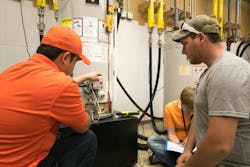
Few environments place as much varied demand on hot water systems as a school campus. Residence halls, dining facilities, athletic centers and laboratories all rely on hot water; they use it in different ways, and often at the same time. It’s a tall order for facilities personnel to meet these overlapping demands without oversizing systems or wasting energy during off-peak hours.
Student housing typically drives the largest spikes in hot water usage, especially in the early morning and evening hours when students are getting ready for the day or preparing for bed. Dining facilities, meanwhile, require consistent hot water throughout the day to meet sanitation and food safety requirements. Athletic facilities will have sudden, high-volume demand tied to practices, games or events. Science labs sometimes need precise temperatures and uninterrupted availability.
Rather than relying on a single, oversized system, many campuses are finding value in more flexible approaches. Load profiling can help facilities teams better understand when and where demand occurs. Zoned or distributed water heating systems enable schools to match capacity more closely to specific applications or specific facilities, reducing standby losses and improving overall efficiency. Modular systems are recommended for their scalability; they enable facilities teams to adapt their approach as the needs of the campus evolve.
By designing hot water systems around actual usage patterns, facilities teams not only reduce energy waste, but also provide reliability for faculty, staff and the entire student body. Hot water systems deserve the same strategic attention from facilities planners as HVAC and lighting upgrades. Proactive planning positions institutions for long-term resilience and sustained energy savings.
Keith Kuliga is the Mechanical Sales Support, Commercial Products, for Bradford White Water Heaters, a five-time ENERGY STAR® Partner of the Year.

Sidebar: Oakland University reopens after hot water system is repaired
Oakland University in Rochester, Michigan, reopened its campus in early January after a failure of its high temperature hot water system caused the university to shut down much of its operations in November.
Leaks in the system, which supplies heat to most buildings on campus, were discovered in November; the university announced that the leaks in the system had been repaired, but in late November, Oakland officials said a new leak had occurred after the system was repressurized.
More than 20 buildings on campus were affected by the failure and had only partial heat. Those on campus were advised to avoid entering affected buildings unless absolutely necessary.
After reopening the campus on Jan. 5, university officials detailed the steps they have taken to improve the system.
"[A]ll residential housing buildings are now supported by redundant heating systems," the university said on its website. "This means that if the Central Heating Plant were unavailable for any reason, heat would remain uninterrupted and student living conditions would not be impacted."
The university also has a redundant heating solution in place for Pawley Hall, which is no longer dependent solely on the central heating plant. Backup or permanent redundant heating sources for other buildings considered priorities are being carried out.