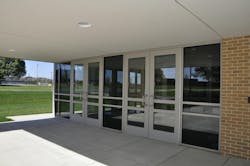
The doors that enable students and staff to enter a school facility may also be the places where unwanted and possibly dangerous people come inside without authorization. Schools and universities must make sure that the doors that let people in incorporate security measures that keep students and staff safe and prevent intruders from entering.
The Partner Alliance for Safer Schools (PASS), in its seventh edition of its School Safety and Security Guidelines released in 2025, recognizes doors as a key element in the overall security strategy on a campus. The guidelines describe the steps school facility managers can take to make sure their doors and door locks provide the most effective building security.
On the perimeter
All entry doors in a school should be clearly marked with a first responder door numbering system, in coordination with local police and fire officials, to ease identification of entry points and help emergency personnel know where they are going.
Signage should be placed on every door notifying all visitors that they must sign in at the front office and that individuals trying to enter without authorization are subject to arrest.
Different doors have different functions and require different security measures. PASS divides school perimeter doors into three categories: primary, secondary or tertiary.
•Primary openings are main entrances, visitor entry center and public entry points.
•Secondary openings are primarily for operational entry points such as staff entrances, doors leading to playgrounds and additional buildings that are typically used on a daily basis for staff access and class change.
•Tertiary openings are emergency exterior doors for egress only. These doors include stairwell doors, and large assembly areas requiring multiple egress.
PASS urges schools to establish a policy that governs when exterior doors are secured or unsecured. To abide by fire and building codes, all perimeter doors should allow free exiting of the building in case of a fire or other emergencies that require evacuation of the building.
For entrances into a building, primary and secondary doors should have electronic access control or a door lock cylinder (if manually operated). Exit devices should have a visual indicator so that security and building personnel can look at the device and determine if it is in a secure condition. These exit devices should allow for dogging (putting into an unlocked state) only by means of a key.
All exterior doors should be electronically monitored to indicate whether the door is open or closed. This is typically done with a door position switch, which is either wired or wireless, and monitored centrally and remotely through a facility’s access control system.
All perimeter doors should be secured when students are in classrooms or when access from the exterior is not required for students to move from building to building. The number of doors unlocked during class changes should be limited. Any exterior doors that are unlocked during class changes should be monitored by a staff member or a school resource officer.
For doors that use a key, schools should establish policies and procedures to govern, track and revoke the distribution of keys. Keys should not be able to be duplicated without following a formal authorization process controlled by school administrators.
In classrooms
Classroom doors should be closed and locked when classes are in session or the rooms are otherwise occupied, PASS recommends. Classroom and corridor doors should be a minimum of 1 inch thick, steel or solid core wood, and installed in steel frame.
Security window film should be installed on all classroom room door vision panels and sidelites. Security film deters or delays the ability of an attacker to breach a doorway using a firearm or other weapon.
Classroom doors should include windows (narrow-lite style) for visual access both inside and outside the classroom. Blinds should be integrated into the design to cover these windows during a lockdown.
Classroom locks should be specifically designed for classroom doors and lockable from the inside of the room. Any lock must allow keyed or electronic access from the corridor side so that authorized personnel can gain access without a special tool or knowledge. Any lock shall always allow free egress from the inside of the room. Locks should ideally have a visual indicator so that the condition of the lock (locked or unlocked) is visible to room occupants.
PASS discourages schools from affixing additional devices, such as “barricade” or “secondary locking” devices, to classroom doors.
The devices “offer no advantage over an existing code-compliant lock ... and most violate fire and life safety codes as well as the federal law,” the guidelines say.
About the Author
Mike Kennedy
Senior Editor
Mike Kennedy has been writing about education for American School & University since 1999. He also has reported on schools and other topics for The Chicago Tribune, The Kansas City Star, The Kansas City Times and City News Bureau of Chicago. He is a graduate of Michigan State University.